Showing posts with label Genealogist. Show all posts

Monday, 30 May 2016

Fears, then Tears

Plenty of people engaged in family history take themselves very seriously, and we tune out ... or our eyes glaze over.

But real-life tragedy abounds in the ‘birth, death and marriage’ scene.

Some years ago I sat beside an attractive young woman in her early twenties who was trying to operate a microfiche reader in the State Library of Victoria. She was very agitated, and constantly slid the reader tray in, out and roundabout, so I asked if I could help. She replied ‘I can’t remember the order of the alphabet.’

Astonished, I asked for the name she was trying to find, and then noted she was searching the Inquests.  I found the surname instantly, and saw the verdict. ‘Oh’, I said, ‘Murder!’ 

She waved a photocopy of an old newspaper article at me. ‘My sister. My mother murdered her.’ Around us, everyone’s ears pricked up.  Her voice broke. ‘Until a few minutes ago I didn’t know I ever had a sister.’ She was shaking uncontrollably. 

Concerned, I said ‘Would you like to come outside with me and have a cup of tea?’

We went to a nearby café. She talked. She cried. She’d been adopted but had some contact with her birth mother’s family. She’d always suspected something major was being hidden from her but she’d never been game enough to try and find out what it was. She’d recently inherited an old house in a desirable inner-urban suburb, the gift of a kind uncle, and didn’t understand why. Pressure was being applied by greedy family members who wanted a share of her windfall.

Today she’d summoned up the courage to come to the Library and ask the staff to help her find newspapers from around the time she was born. The duty librarian found the confronting details of her background  – her pregnant drug-addicted mother had killed her toddler sister. As a newborn she herself had endured drug withdrawal symptoms and she was removed from her mother’s ‘care’ by the authorities.

I struggled to reduce her anxieties. ‘Am I going to turn out like my mother? I was born a drug addict.’ She sobbed again. ‘The worst part is the knowledge that I once had a sister. A sister. I’ve always wanted a sister.’ And so it went. I sat listening and talking with her for a long time, advised her to seek counselling and advised her not to sign any documents in her distraught state and never without independent advice.

I saw her onto the tram, on her way home to her boyfriend, returned to the Library and approached the librarian who’d found this sensitive material for her and handed it over so matter-of-factly. ‘Didn’t you see how distressed she was when you found that article?’ 

‘Oh’, tossed off the librarian, ‘the things people find out here, we really need to employ a full-time counsellor.’

Thursday, 13 March 2014

Writing a Brief, Finished Piece


Family history research can go on and on, without any obvious ‘output’. Are your relatives tired of hearing about the people you are researching? Are their eyes glazing over? Are they tired of hearing about the story you’ll write ‘soon’. With family history, it is hard to know when to call a halt to your research. Sometimes you need an incentive to finish something and see a result for your efforts.
Writing a 1,000-2,000 word article for publication can be just what you need to stop procrastinating and galvanise yourself to action. Note the operative words provided by the headline. Writing. Brief. Finished. This is your challenge.
The need to tell a good and interesting story within a limited word count provides very good training for any writer, especially a family history writer. The task requires you to: 
  • Focus on the story – what is it? 
  • Focus on your principal character, with no superfluous digressions about other characters. 
  • Organise and shape your work into a coherent structure. 
  • Avoid verbosity, by using succinct wording.
There are many potential awards for articles about distinctive individuals or stories within your family. You could choose any one or more of the following:
•       ABR Elizabeth Jolley Short Story Prize, for 2,000-5,000 words
•       Banjo Patterson Writing Awards, for 3,000 words
•       Cancer Council Arts Awards, for 1,000 words
•       Federation of Family History Societies, UK, for 1,000 words
•       Henry Lawson Society Literary Awards, for 1,000 words
•       International Society of Family History Writers & Editors, American award, for 5,000 words
•       Janet Reakes Memorial Award, for 2,000 words
•    Lord Mayor’s Creative Writing Awards, Melbourne, includes awards for 3,000 words (short story) or 10,000 words (narrative non-fiction)
•       Rolf Boldrewood Literary Awards, for 3,000 words
•       Story Writing & Art Competition, for 3,000 words
•       The Stringybark Short Story Award, for 1,500 words
As an example, let’s consider the requirements for the Janet Reakes Memorial Award, which I entered in 2011. The topic was ‘My Most Unusual Ancestor’. The guidelines for that particular competition specified an article presenting an interesting biography, yet also explaining the genealogical steps involved in 'uncovering' the story, all within a maximum of 2,000 words, excluding citations. Articles not fully referenced would be automatically disqualified, making this a competition perfectly suited to the rigorous ‘academic’ standards demanded of a family history writer.
After reviewing all my possible ancestors, I decided to write about a certain Dr George Young, c.1726-1803, the man who established the western hemisphere’s first botanic garden, on the Island of St Vincent in the 1760s. Exploring the history of the Caribbean at this time, I’d compiled research material totalling 15,700 words. Trying to focus on what seemed important in George Young’s story, I culled the material to an article of 7,206 words (Competition Draft No 1).
After further consideration of what was specifically relevant to Young, and the events which moved his personal story forward, Competition Draft No 2 contained 2,039 words. Yet this draft was all about him; it was his short-form biography. I had not explained why I’d chosen him as my most unusual ancestor, and how I’d uncovered his story. In other words, I had not addressed the guidelines for the competition.
To make sufficient space for these issues within the overall word limit, more editing work was needed. Every ‘point’ brought into the story and needing explanation was omitted if not essential. Strict attention was paid to saving words by deleting padding & digressions. Some examples of the culling process follow, where 57 of the words which were deleted from Draft 2 are in bold script:
  • Britain’s Seven Years’ War against the French commenced in 1756, soon after George Young graduated as a Master of Arts from the University of Glasgow in 1754. His education proves that his family had money but his name is a ‘common’ one and it’s frustrating that his origins remain unclear, except that he was born around 1726.
  • In 1765 Governor Robert Melville visited St Vincent. Melville had also studied medicine and was a member of the Society for the Encouragement of Arts, Manufactures and Commerce in London.
  • The garden had high strategic priority, facilitating the economic development of Britain’s overseas possessions by allowing experiments in acclimatization of basic foodstuffs and medicinal plants to be undertaken in the tropics. Accordingly, its control was entrusted to the Secretary at War in London, to whom regular reports were to be transmitted. (NOTE - There was no need to include this fact in the body of the article as it appears as an endnote, not counted in the word limit.)
  • His will also named three children, George, William and Sarah, in that order. The George Young buried on St Vincent on 8 June 1767 may have been a fourth child, placing the surviving George’s birth around 1768 to 1770 but no baptism has been found for George Jnr.
By examining meanings and rewording for more concise expression of the same ideas, many more words were saved. Consider the following paragraph, for example:
•       While British attention was focused on the American War of Independence, the French gained an advantage in the competition for the sugar riches of the Caribbean and recaptured their old possession. Dr George Young was a member of the Council of St Vincent when it capitulated to the French in June 1779. British forces retreated from the island and local farmers began encroaching on the garden, growing cotton and tobacco. A hurricane in October 1780 wreaked further destruction on Young’s creation. He now resided with his wife and family at St Lucia, providing medical services as Physician (a more senior medical role than Surgeon) to both the Windward and Leeward Islands. Late in 1783, after the war ended, Young returned to St Vincent on half-pay, as was customary during peace time. In 1784 he was approaching sixty……..
The 137 word paragraph (above) became the next paragraph, with 91 words:
•       While the British were diverted by the American War of Independence, the French pounced, and Dr George Young was a member of the Council of St Vincent when it capitulated to the French in June 1779. British forces retreated to nearby St Lucia, where Young was on the army payroll as Physician. Local farmers on St Vincent began encroaching on the garden, growing cotton and tobacco. A hurricane in October 1780 wreaked further destruction on Young’s creation. When the war ended the ageing Young returned to St Vincent on half pay……….
The culling process freed up enough space for the extra words needed to satisfy the competition guidelines. The article’s final structure, when analysed, comprised roughly 25% on the ancestor selection process (woven into the story), about 25% on the ancestor search process (also woven into the story), and about 50% on Young himself. The endnotes were quite extensive but were excluded from the word count.
Competition Draft No 3 contained 1,999 words. It was emailed to several people as a check on its clarity of meaning. After I’d culled so much, could they easily follow the resulting story? A few useful suggestions led to several minor adjustments.
Then came the final test: meeting the competition deadline by submitting the entry on time. No more dithering, tweaking or refining could occur. On the day before entries closed, I pressed the ‘send’ button and hoped for the best, feeling grateful that I’d learned a great deal about tightening up the purpose and focus of any piece of writing. The process has value for all writers.
This article, based on a Workshop given by Louise Wilson to the GSV Writers’ Circle on 4 September 2013, was published in Ancestor, Quarterly Journal of The Genealogical Society of Victoria Inc, Vol 32, Issue 1, March 2014, pp 38-9

Tuesday, 7 January 2014

Louise's Albatross

[An abbreviated form of the article below was published in December 2013 as a 2½ page Feature Story in The Genealogist, the family history magazine of the Australian Institute of Genealogical Studies Inc.]
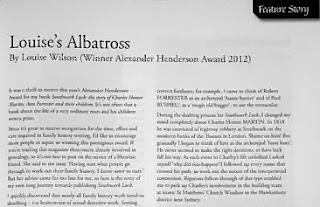
It was a thrill to receive this year’s Alexander Henderson Award for my book Southwark Luck: the story of Charles Homer Martin, Ann Forrester and their children. It’s not often that a book about the life of a very ordinary man and his children wins a prize.

Since it's great to receive recognition for the time, effort and care required in family history writing, I’d like to encourage more people to aspire to winning this prestigious award. If you’re reading this magazine then you’re already involved in genealogy, so it’s too late to pass on the advice of a librarian friend. She said to me once ‘Having seen what people go through to work out their family history, I know never to start.’ But her advice came far too late for me, so here is the story of my own long journey towards publishing Southwark Luck.

Where genealogy is concerned, I didn’t start out to write anything. It all started in 1999 as a kind of computer game when I saw the software package ‘Ultimate Family Tree’ on sale at Officeworks. I’d reached my fifties and had started to think about the whole idea of ‘where I came from’, an idea picked up so well in the subsequent SBS TV programme ‘Who Do You Think You Are?’ At the beginning my aim was simply to collect information together and input that information to the genealogical database. Playing with the software was like playing with a new toy.

I quickly discovered that nearly all family history work involves sleuthing – the brain strain of actual detective work. Sorting out the relevant connections to your family line is one of genealogy’s great attractions – the thrill of the chase. It’s very addictive. Why don’t they divert problem gamblers onto this path – it would be much more productive for all concerned!

But I digress. Using BDM certificates ordered from England, NSW and Victoria, and laborious examination of microfilms of parish records, I slowly built up a family tree going back at least six generations for every line in my mother’s family. Even though most of the surnames in her tree are fairly ‘uncommon’, such as Pierssené, Flockton, Butterfield, Bushell, the startling result was a database containing almost 25,000 names, all of which emerged from my efforts to find the right ‘lines’ and exclude the wrong ones.

After discovering that some forebears were early convict settlers of Australia, I found some biographical data about these people in reference texts such as those by Mollie Gillen and Michael Flynn, transcribed it, cobbled bits and pieces together in pastiche form and added these scrappy bits of storyline to my software programme. This massive data collection and digestion process took some years – about five. One of my sisters began to refer to this project as ‘Louise’s albatross’. My daughter jokingly started calling me her ‘lost mother’.

Along the way I discovered that the software printed out actual reports and, once I saw a burgeoning narrative for each individual, I became aware that there was great potential for writing that person’s life story in a much more satisfying way than the software allowed. At that point, around 2004, I printed out the entire report for every one of my mother’s forebears, and saved it as a Word document, not in a form that would interest anyone.

It was an ‘ah hah’ moment. Seeing that huge outpouring, I realised I could not waste all my research efforts. I could not leave digital files sitting inside my computer, or hard copy files stashed on my study’s shelves, liable to be promptly discarded should I be hit by the proverbial bus. The information needed to be disseminated in a coherent way. The year 2004 was my starting point as a writer of family histories.

From the outset I had one personal guideline - I most definitely did not want to publish a book with pages and pages of descendancy charts, although some authors focus on this. The latter might maximise sales at a family reunion, as everyone likes to see their name in a book, it seems, but this approach did not appeal to me. Dealing with the privacy issues did not appeal either. I made an early decision that my cut-off point for research was 1900. Anyone born after that date would have to be someone else’s research project.

As I read that totally fragmented and very boring initial Word document, based on the contents of a database, some of the characters intrigued me. I realised how important it was to put more flesh on their bones, fill the gaps and make their stories meaningful. For this process, the word ‘disinterring’ seems most apt. Bringing a person to life became my objective, but as a novice writer in this field I was unsure of the best way to proceed. A line in Muriel Barbery’s book The Elegance of the Hedgehog resonated with me: ‘history is a list of events joined by logical connections’. I realize that’s what I instinctively tried to do, right from the start. Make the story flow.

It’s easier said than done. Creating a ‘flowing’ document is a particular challenge with a family history. Usually you don’t know the story when you begin. You may have no idea of what you’re looking for. You unearth hitherto unknown events which may or may not be relevant. Disjointed sections of a life story emerge as you immerse yourself in the life concerned. You try to imagine possible scenarios, and then go looking for supporting or refuting evidence. I talked to many extended family members and am very appreciative of the stories they were able to contribute. But research only comes together, becomes meaningful, once you embark on the serious undertaking of writing a book and all the gaps are exposed. So it’s a good idea to start writing early.

Over time I discovered that ‘flow’ happens once you imagine yourself living the life of the person you are writing about, once you can picture that person in your mind. Among my convict forebears, for example, I came to think of Robert Forrester as an archetypal ‘Aussie battler’ and of Paul Bushell as a ‘tough old bugger’, to use the vernacular.

During the drafting process for Southwark Luck, I changed my mind completely about Charles Homer Martin. In 1818 he was convicted of highway robbery at Southwark (pronounced Suthuck), on the southern banks of the Thames in London. Shame on him! But gradually I began to think of Charley (as he was known), as the archetypal ‘born loser’. He never seemed to make the right decisions, or have luck fall his way. We know that plenty of people are like that today. As each event in Charley’s life unfolded I asked myself ‘why did this happen?’ I’d do some thinking and go looking for the answers. I followed up every name that crossed his path, to work out the nature of the interpersonal connection. Rigorous follow-through of this type enabled me to pick up, for example, Charley’s involvement in the building scam at iconic St Matthews’ Church, Windsor, in the Hawkesbury district near Sydney.

I’ve jumped ahead of myself a little, by skipping over how I moved from the printed-out contents of a database to writing Southwark Luck. Being a romantic at heart, my initial passion was to work out how each couple met. That was when the fun began, the deep delving to find the circumstances of why two people happened to be in the same place at the same time and decided to marry. Hence the title for that first single gigantic Word document of mine was How Cleon Met Thea. Cleon and Thea were my maternal grandparents, and they shared quite a compelling love story. I tried to draw together the various strands of family history which led to their marriage. I followed their life as a married couple by exploring the lives of their children, whose births, deaths and marriages provided valuable details for the addresses and occupations of Cleon and Thea.

The data began to overwhelm me. The more information I found, the larger the book became. I decided to split my ever-expanding file into two draft books, now with the titles How Varah Met James (these were Cleon’s parents) and How Dolly Met Philip (these were Thea’s parents). The process snowballed. Progressively I split the ‘books’ in half, then half again, each time focusing on the couple where the strands met. Over time, I collected so much material that, by 2013, one Word document generated in 2004 had morphed into five published family histories, with another coming in 2014, six additional books in draft form already residing in my computer and further ideas inhabiting my head space.

It’s obvious that the quantity of information collected becomes a determining factor in creating a printed family history document. The likely page length is important. But I agonised about other aspects of structure - how to organise and present voluminous details to make them less complicated and less confusing. It was my biggest challenge.

At one stage in my life I was a maths teacher in a secondary school and the golden rule was to teach one concept at a time in any single lesson. I thought the same principle applied to writing a book – it should have a clear focus. I asked people for ideas. I looked at other family histories for clues and tried different models. For example, my first book on the Pierssené family provided an overview of twelve generations. My second book followed the Dennis family as a direct descendancy from 1650 in Saint Buryan, Cornwall to my grandfather in Bondi, Australia, providing brief details of each new wife’s own family background as she married into the Dennis family. Neither approach satisfied me.

With any book, as I finish the last page, I always ask myself the same question – why did the author bother to spend all that time and effort writing that book? And as I pondered my own family tree, I constantly asked that question of myself – why would anyone want to read a book about this topic? Who are the likely members of my audience? To me, that should be the focus for every writer. As family history research took over my life, I asked myself another question. If I restricted my book to my specific forebears, those individuals would be of interest only to my three sisters, my daughter and grandchildren, a few cousins and some nephews and nieces, most of whose eyes glazed over at any mention of their forebears.

Eventually the penny dropped - I should focus on various people many generations back, because of the much greater number of descendants who might be interested in that individual’s story. A book structured around a couple, their children and grandchildren seemed to make sense as well, as this span in a family is comprehensible to everyone. After that, family histories can often become too long, too scrappy and too confusing, with no narrative ‘thread’.

At that point in my evolution as a family history writer I split my books even further. It became obvious that where my convict forebears were concerned, their individual stories had never been told and they had thousands of descendants in Australia, some of whom would surely be interested to know about Australia’s earliest days. Each convict warranted a book all to himself. And that is how I came to write Southwark Luck, the third in my series about early convict settlers of the Hawkesbury. It’s classified as a family history because it includes the stories of Charley’s children and grandchildren. The two earlier convict books were biographies, with the children and grandchildren relegated to sequel books, because otherwise the books would have been too long.

I have long since given up on the book title theme I started with, How Cleon Met Thea. Now my titles more clearly define the family name, to make it easier for other researchers and extended family members to find my work. Perhaps Robert Forrester, First Fleeter is boring as a book title, but as a self-published author, using only the internet as a promotion tool, it has allowed me to create a market for the book. Any Googler who discovers Robert as a forebear will also discover my book. With Southwark Luck I tried to compromise with a catchier title, but the book’s subtitle clearly spells out the people about whom the book is written.

Once I’d settled on structural focus for a particular book, I grappled with the big challenge of making its storyline interesting. I thought about my work during my morning walks, and as I read other material. Much of the content of history and family history books written in the last twenty-odd years seemed very patchy and unsatisfying, kind of glib and not getting at any fundamental truths.

However, when reading Colleen McCullough’s book Morgan’s Run, I marvelled at the way she had developed a few basic facts of a trial, a First Fleet voyage and the first five years in the colony of NSW into a 600 page novel. She also included a great description of the life of a sawyer. Charley was a sawyer at the Hawkesbury, so now I could more easily picture his life.

The approach taken by Kate Grenville in her books was thought-provoking too. The Secret River deals with a period on the Hawkesbury similar to the date of Charley’s arrival. One commentator told me that Kate and I have focused on something similar, the difference being that when novelist Kate gets to something she doesn’t know about she imagines it and writes accordingly, whereas non-fiction writer Louise goes looking for the answers. I’m too embedded in years of mathematical proofs to be comfortable with making things up.

Basically, I am writing so that I might gain an understanding of a direct forebear. But I don’t want to write a book which is too personal, too full of references to my gr-gr-gr-grandfather, and so on. I want to make the book as inclusive as possible – so that other descendants and even ‘outsiders’ will feel that the book speaks to them too.

An essential ingredient for any valuable family history is the source of your information. Proper citations avoid a lot of unnecessary email correspondence. The process of inserting a source as a footnote or endnote is very easy using Word, and a whole lot easier if you start writing your story early, including the source details as you type your story into the document. Having spent hours trying to work out where some writers have obtained their information, and having gradually realised how sloppy and inaccurate is much that is written as ‘history’, even by academic historians, I determinedly source everything, wherever possible. Regarding complex sentences containing several sources, I try to restructure them as simple sentences, so that each sourced ‘fact’ has a fully documented endnote. Citations can be made to look quite unobtrusive but I know they are useful, as many readers have told me how much they study the endnotes section of my books.

I always work in Word, with the whole document open at once, so that information can more easily be moved to better or more appropriate places in the story. I use lots of sub-headings, with the ‘navigation pane’ always open on the left hand side of the document, to keep my focus firmly on the storyline of the document. If my subheadings bore me, then they’ll certainly bore a reader, so I try to find more material to increase the interest factor. Many of the subheadings are deleted in the final drafting stage, once I have found ways to group related material together, perhaps into a small chapter of its own. For example, while Southwark Luck basically told a story in chronological order, the Bushell book contained many themed chapters.

Many, many changes and rewrites are made as the book slowly takes shape – sometimes quite radical changes, if a new piece of evidence is unearthed contradicting my previous understanding. I constantly ask myself the question – what point am I trying to make here? This enables me to keep stripping away the superfluous and extraneous material, for consignment to an appendix or endnote.

I’m not keen on text boxes and other devices which clutter up the page and distract attention from the main storyline. Nor am I keen on two-column pages, which I find difficult to read. My family history books have all been self-published in A5 format, a size which makes the book cheaper to publish and easier to read and store on bookshelves. That A5 size can detract from the pictorial aspects of the book but my focus is always the intellectual content and no-one has yet lambasted me for shortcomings with images, even where they exist.

A foible of mine is using words of the era to tell the story, wherever possible, because re-interpreting them often changes the meaning completely. It’s the ‘Chinese whisper’ phenomenon. Some people’s comprehension skills leave a lot to be desired. But I break up the quotes with explanatory comments wherever possible.

Rushing a family history into print is not a good idea, but problems of accuracy emerge when you take a long time to write the book. As your research skills improve, you wonder about your earlier work and you may need to spend time re-checking. You also need digestion time. I often ponder things, or come across a new idea or new piece of background information when viewing a movie or reading a book about a completely unrelated topic. I delay publishing until I have explored all possible options for resolving any matter I’m unsure of, or which puzzles me.

Then the law of diminishing returns applies: if you keep on looking and not finding, it’s time to stop researching and proceed to publishing. It goes without saying that the quality of the research and thinking behind a family history will be the ultimate key to its success.

The process of writing it, of attempting to convey ideas and information clearly, may not come easily. However, few things are as satisfying as the feeling that your published work has helped people to discover their roots, know where they came from and understand themselves a little better.

Tuesday, 20 August 2013

Oh, the places you'll go (with genealogy)

Belonging to any group can impose certain obligations – explicit, or implicit - and I’m a sucker for that awful ‘sense of duty’ assailing the eldest child in many families. (Yes, I’m an eldest child, with three younger sisters.)

That phenomenon must explain why I recently found myself offering to help out the Genealogical Society of Victoria (GSV) with a writing task. They were stuck for someone to write short articles about genealogy for 'Fifty Plus News'.

My two contributions draw heavily upon one of my favourite Dr Seuss children’s books for inspiration. The first instalment was published as ‘Oh, the places you’ll go’ on page 7 of the July 2013 Fifty Plus News magazine. The second instalment, ‘Just go right along. You’ll start happening too’, is on page 7 of the August 2013 Fifty Plus News.


Monday, 24 June 2013

Alexander Henderson Award, 2012


It's great to receive recognition for the time, effort and care required in family history writing! Yesterday I won the Alexander Henderson Award 2012 for my family history book Southwark Luck, the story of Charles Homer Martin, Ann Forrester and their children. It’s an Australia-wide competition, run by the Australian Institute of Genealogical Studies in Melbourne. Here I am, receiving the award from AIGS President Gail White at the lunch, attended by about 150 people.

It was also an important occasion for the AIGS, which celebrates its 40th birthday this year. We are very grateful for their efforts in running the annual AIGS Awards, especially the volunteer efforts of the judges, experts in their field, who have to read all the entries and draw conclusions.

Writing a family history involves a specific set of skills, and I've been helped by the Genealogical Society of Victoria's Writers' Circle. Two other members of our writing group also featured in yesterday's event, making for three happy faces at our next meeting:
• The Travelling Scotsman - the Life and Times of Paterson Saunders, Snr by Mary Anne Gourley – THIRD PLACE IN DON GRANT AWARD (for biography)
• Across the Tasman - the Family of James McDowell from Scotland to New Zealand and Australia by Margaret Whitaker – HIGHLY COMMENDED IN ALEXANDER HENDERSON AWARD (for family history)
• Southwark Luck – the story of Charles Homer Martin, Ann Forrester and their children, by Louise Wilson – WINNER OF THE 39th ALEXANDER HENDERSON AWARD (for family history)

All three books were printed by Sylvie and Michael Blair of BookPOD. They do a wonderful job. Our books are available for purchase through the BookPOD website - just click on the Family History tab to make your selection. BookPOD provides a great way to sell your books online without all the hassle and expense of running a ‘shopping cart’ system yourself.

By the way, my book ‘Paul Bushell, Second Fleeter’ was submitted two years ago as an entry for the Alexander Henderson Award - BUT, along with Mary Anne Gourley’s book, it was deemed by the judges to be a biography rather than a family history and was disqualified. Both books were set aside for a year (by the AIGS), for consideration in the inaugural Don Grant Award for biography, but my book was 'lost in the system' somewhere and never went before the judges.

At the lunch yesterday, I was seated next to the winner of the first Don Grant Award, Dr Geoffrey Morgan, active in the Queensland Family History Society. The second place-getter in the Alexander Henderson Award was Patricia Kennedy from NSW – also seated at my table. She’s a graduate of SAG’s Diploma course in Family History and her card reads ‘genealogist and historian’. Given the market-place constraints of our genre, all three of us are testaments to the worth of setting up a family history book yourself, in Word, saving in PDF format, and self-publishing.

Thursday, 28 February 2013

Non-Fiction Detail

As a non-fiction family history writer, the issue of an appropriate level of detail is something I grapple with constantly - how much is too much?

For example, when reading Brenda Niall's (non-fiction) biography of Georgiana Macrae, Georgiana, I frequently found myself bogged down in some very dense material and carried forward in the progression of the story only by the chapter headings. Yet Ken Follett's (fictional) novel The Pillars of the Earth, containing masses of detail about the techniques used to build medieval cathedrals, managed to keep my interest engaged for over 1,000 pages.

This raises another vexing issue - the need to balance 'explanations' against the overall length of a book. I belong to a family history writing group, where the members provide each other with an informal critiquing service and constantly demand that more information be provided: more descriptive details of a place, or an occupation, etc. This form of micro-analysis might improve one page, but taken to an extreme will make for a very long and boring book at the macro-level. Is this level of research effort and detail warranted if there's not much of a story to tell in the first place?

As a writer I try never to forget the golden rule I learned as a maths teacher many years ago - the need for each lesson plan to be built around conveying and reinforcing one idea at a time. Writers also need to be rigorous in their self-assessment of the intellectual idea or concept they are trying to convey in any one publication - its underlying premise.

Such considerations guide my decisions about the actual content of any single book. Sometimes I follow the more traditional format for a family history, providing short snippets about individuals while following a family line down through many generations, as with the Pierssené and Dennis books. In other cases, where I have a great deal to say about an interesting individual, I narrow the focus of the entire book to that one person. Robert Forrester, First Fleeter and Paul Bushell, Second Fleeter are examples. Southwark Luck adopted a hybrid format - with half the book devoted to one man and his wife and the remainder telling much shorter stories about each of their children. Each of the latter chapters could have been much longer, with more extensive research, but then the book overall would have been far too long.

Trying to streamline a story by shortening (or removing) unnecessary descriptions, by moving extraneous detail to appendices and endnotes, or by deleting material altogether, creates a whole new set of problems - will the readers follow your train of thought? As one of my writing friends expressed so succinctly: 'For every shortcut, a reasonable question follows' (in the minds of readers).

All of this just goes to show that the act of writing a book is a high-level intellectual endeavour, requiring the writer to make constant value judgments about the words being committed to the page and the impact of each word on the reader.

Friday, 20 January 2012

Placing a Value on our Family History

Coming from a professional career background in economics and finance, it has annoyed me for years that some activities are valued commercially and count for something, but other activities count for nothing. In particular, much of the work of women in families and the work of volunteers in various community roles is not counted as ‘valuable’ because it is unpaid. Even if it represents ‘good deeds’ and is a serious work commitment, it is not taken seriously. Family history is a case in point, often written off as a retirement or hobby activity, whose proponents must be humoured in their funny little obsession. What’s more, family history has the reputation of eye-glazing boredom for anyone not belonging to the family concerned. As a writing genre, it is too easily dismissed.
For reasons such as these, writers of family history tend to be a bit apologetic about what they do, yet their work can hold great intrinsic value. Once the basic needs for human survival – food and shelter - have been satisfied, people move up through Maslow’s hierarchy of needs and eventually crave understanding of their roots and where they came from. The person who can commit a family story to the page in an interesting way will capture the reader’s attention and earn the undying gratitude of current and later generations. Unlike many other forms of communication, a book remains accessible for hundreds of years, so one’s work can have lasting value.
Family history writing can be good writing, and is rewarding when it generates praise from readers such as ‘I really feel as if I know that person, my forebear’, or ‘thank you, I can feel proud of my heritage now’. The Writer’s Circle of the Genealogical Society of Victoria offers feedback, encouragement and some opportunities for skill development to those trying to write their family stories. The Alexander Henderson Award of the Australian Institute of Genealogical Studies fosters a professional approach to writing and publishing family histories.
But how should one place a dollar value on one’s efforts? State governments, for example, have no qualms about valuing their information- they charge prices ranging from $17.50 to $41 for a single historic birth, death or marriage certificate. Yet the tradition among amateur genealogists is that information is exchanged for nothing.  However some people have done more work than others, sometimes a lot more, so what is a fair exchange?  I myself don’t do much actual sharing, mainly because I don’t want incorrect information being circulated in my name but outside my control. I prefer to wait until I have finished my research and have developed a coherent and hopefully factually-correct story– then I share everything via my published book.
Publishing books costs money, so how much should one charge? If one were to try to recoup the years of research time and out of pocket expenses, the recommended retail price (RRP) for a family history book would be prohibitive. The RRP for any book needs to fit within the overall pricing structure for the wider book market, itself changing rapidly with the internet and the forward march of the digital era. Yet for a family history book there is a difference – in marketing parlance, it has a ‘long tail’. It does not require a massive publicity splurge to maximise sales in a particular month before pulping what does not sell. A family history book may continue to sell long after publication as the ripple of awareness spreads to ever more distant branches of the family.
So a wider market may exist, but family histories rarely benefit from the cost savings of mass production, making them expensive to print. Apologetically, publishers of family histories hope that buyers will pay at least enough to cover the printing costs of the book.
Should the buyer pay more? Definitely.
Consider the mindset in other fields of cultural endeavour. An artist I know invests heavily in framing her paintings, as the right frame is the key to selling a picture. Since the gallery then takes one third of the asking price as commission, she bases her asking price for a painting on a multiple of three times her framing cost, in order to make for herself at least as much as the framer makes from her work. A book often represents years of time, not hours or days as for an artist, so how much more relevant is this mindset to pricing family history books? The true cost of production (the afore-mentioned research time and out of pocket expenses) can never be recouped, but the author should surely expect to make at least as much as the printer, the book retailer and the post office (if the book is mailed).
Continuing the art analogy – artists traditionally use a gallery owner to promote and sell their work. What can a family history writer do, especially when commercial publishers show no interest? Self-publish, and self-promote through the internet, of course is today’s answer.
Self-publishing is looked down upon in the traditional world of publishing, but it is beginning to overturn the old publishing model. The advantages are obvious for a family history book. Self-publishing 500 copies of a black and white publication, at a production cost of $10 and RRP of $30 per copy, for example, generates for the author a net return equivalent to 3,300 copies sold on the basis of a 10% royalty.
Self-publishing means that you set up the whole book yourself, with or without help, save the document as a PDF file and take it to a printing company specialising in book production. Such companies will usually handle technicalities such as the cover.
Self-promotion using the internet means setting up your own website as your shopfront, and/or using the online bookshop facility offered by ‘print on demand’ companies such as BookPOD in Melbourne. Customers of online bookshops pay by credit card or Paypal and the book arrives in the mail. Passive marketing of this type can be supplemented by Googling to find specific marketing opportunities and directly contacting potential customers by email.
In this way, you can manage the whole process, including deciding the size of the print run, determining the retail price and controlling where the book is sold. It is a way of valuing oneself. Don’t give away your family history work for nothing!
© Louise Wilson. Please obtain permission to republish.
This article formed part of a talk given by Louise Wilson at the GSV Writers’ Circle on 1 September 2010. It was first published by Genealogical Society of Victoria in 'Ancestor', Vol 30, Issue 5, Mar 2011. Also published by Western Australian Genealogocal Society in 'Western Ancestor', Vol 11, No 12, Dec 2011