Showing posts with label Personal. Show all posts

Saturday, 4 April 2020

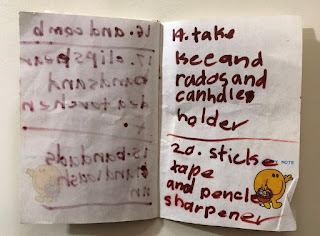
Radar's and Thea's Running Away Book

About 40 years ago a little 'Mr Happy' booklet came home with my young daughter Thea after she'd spent the weekend with her Dad. The handwriting belonged to her stepsister Radar, a year older. I opened it with trepidation. Was I going to discover some unpleasant truths?
The lack of apostrophes on the title page was quickly ignored when page 2 proved they had no intention of getting lost. Radar helpfully provided her home address and phone number.
Thea wasn't quite sure of hers:
It was pleasing to see that the primary safety lesson instilled in both girls had been absorbed - 'stay together'. And it seems they were a bit scared of the dark.
They planned to keep warm:
And they did not intend to starve:
Hmm, we must have done something right as the parents of young children, as their food preferences were encouraging:
No squatting on the ground for this pair - chairs would be much more comfortable. I heaved a sigh of relief at this point as the 'pads and pencils' item proved they intended to stay in touch, even if they were running away.
They'd keep boredom at bay with a spot of reading, planned to keep themselves clean and, being good little Aussie kids, they knew they had to be Sun Smart.
No finger food for this pair - tableware was needed. By now it had almost reached the stage where a removalist would be needed to transport the load:
They paid impressive attention to personal grooming issues and first aid supplies:
They'd learned to count without making a mistake, even if their spelling was a little haphazard:
Craft activities were in order, with sticky tape, a pencil sharpener, a rubber and glue on the list. And last but not least was the most important thing, made evident during this COVID-19 pandemic:

It was a relief to reach the end and discover that they just wanted an adventure. No mention of wicked stepmothers or stepfathers.

This little booklet remains one of my treasured possessions. I love it. Thank you girls. Now that COVID-19 has struck and you're confined to barracks with your own children, I hope this story will amuse them for a moment or two. 

Thursday, 25 January 2018

Melba's Gift Book of Australian Art and Literature

Last year a friend from my Sydney 'high finance' days, Julie Cleary, visited Melbourne from her home in New Zealand where she has lived for more than 20 years. It was just like yesterday, seeing her again. Lovely. She brought with her from New Zealand a special gift, a one hundred year old copy of 'Melba's Gift Book of Australian Art and Literature', which I was thrilled to receive.  
Melba's Gift Book, 1915
Afterwards, when I sent my thanks, this email came back, explaining how the book came into Julie's possession:
There is quite a story to it, in that our neighbour was a recluse and a hoarder of considerable volumes of everything. In the five years we have lived here I spoke to her three times and then only about getting her trees trimmed - spectacularly unsuccessfully, I may add. She simply shunned people and loved trees.
Recently she fell ill and died shortly thereafter. Somehow I was charged with getting the house cleaned out, a mammoth task. Four industrial-sized bins were filled with rubbish. The Melba book was one of the few things worth saving and I strongly feel it ought to be in Melbourne with someone who appreciates it.  I know you are the perfect recipient.  Julie xx
Perfect is right, for reasons Julie would not have known. For a start, it sparked nostalgia for all the trips I made up and down the Melba Highway during the years when I lived at Yea. Dame Nellie Melba, 1861-1931, the famous opera singer whose choice of stage name honours her home town of Melbourne, owned a country estate at Lilydale. The road now bearing her name branches off the Maroondah Highway on the corner of her old property and heads northwards to Yea.
Dame Nellie Melba, Frontispiece in 'Melba's Gift Book'
A second reason was the purpose of this book. I opened it to find the inside front cover personally autographed by 'Melba' at 'Xmas 1915' as part of her extensive fund-raising efforts for the Belgian Relief Fund in the Great War. This Fund I knew about. Among the Great War letters written by my grandmother's Boulton brothers and published in my recent book 'Brothers in Arms' are one or two letters singling out the pitiful state of the Belgian refugees who reached England in 1914, after their country was invaded. Until I held Melba's book in my hands and read her two-page introduction I didn't know that she too was so moved by their plight that she conceived this book project and donated all its proceeds to the Fund.

Her introduction is followed by 49 other short items, stories and poems contributed to Melba's 'cause' by writers who remain household names today, including Ethel Turner, Mrs Aeneas Gunn, Henry Lawson, C.J. Dennis and Dorothea Mackellar. Lavish illustrations, 34 in total with some plates in full colour, were donated by famous artists such as Norman Lindsay, Hans Heysen, Will Dyson, Arthur Streeton, Fred C McCubbin, Julian Ashton, the children's book illustrator Ida Rentoul Outhwaite and the botanical artist Ellis Rowan. Here was a third reason to love receiving Julie's unexpected gift - the beauty of its words and pictures takes me back into another era.

There was also a fourth and final reason. Ellis Rowan's black & white painting 'A Wild Garden' grabbed my attention, as the subject of my most recent book 'Margaret Flockton: A Fragrant Memory', was another botanical artist. Clearly Margaret Flockton (1861-1953), for all the recognition she receives today and the international art award in her name, did not mix in Nellie Melba's circle of fame back in 1915.
Ellis Rowan's 'A Wild Garden'
Clearly there are many reasons for me to treasure this book. Thank you, Julie Cleary, for saving it from the skip and placing it in my care. 

The book has great significance for others too. In recognition of 'Melba's Gift Book' as one of the best examples of WW1 fund-raising efforts, and as part of the centenary events commemorating the terrible period in world history from 1914-1918, work from this book is currently on exhibition. Signifying Melba's connection with Lilydale and the Melba Highway, the exhibition is on show at the Yarra Ranges Regional Museum, 35-37 Castella St, Lilydale. The Museum is open every day, 10am-4pm, free entry. The exhibition closes on Sunday 4 February 2018.

Tuesday, 23 January 2018

The 'Banter Benefit' of Family History

The following exchange of emails epitomises the rewarding relationships you can discover and establish through family history research. Stephen and I are third cousins. We didn’t know each other 15 years ago and never dreamed the other existed. Now, every time I see an email arrive from him I smile in anticipation of his banter. Here's the latest example.

9 Jan 2018, 5.14 pm
Are you out there somewhere ?
Hello Louise,
I hope this email finds you well.
We haven't heard from you in such a long while and of course, we missed your Christmas 'letter' this year.
How the heck are you ?
Steve & Glenda [B….]

9 Jan 2018, 7.00 pm
Re: Are you out there somewhere ?
Hi there, B…. ‘cousins’
Yes, I’m still here, beavering away in South Melbourne. My last-minute-Louie message at Christmas left a few people off the list. Sorry!
Here’s the message, since you’re interested.
I hope you are both well.
L xx

9 Jan 2018 7.55 pm
Thank Goodness
Thank goodness you are OK Louise...
We were both really VERY concerned for you.
You have made us feel a part of your family with the Christmas message each year and when it didn't arrive we suspected the worst.
Enjoy the evening,
Your sooky cousins from Knoxfield.
S & G.


10 Jan 2018, 7.28 am
Re: Thank Goodness
Love your emojis!
In return - what’s your news?

11 Jan 2018, 9.12 am
Late News
Hello Dear Cousin,
We are not ignoring you... Glenda produced a Christmas message which was sent out last month and it is this that we would like to send you BUT; she can't find the file on her computer.
Please be patient while we look under and into everything in an attempt to find it.
Mr B.

17 Jan 2018, 9.55 am
Re: Late News
Still waiting!!

17 Jan 2018, 7.48 pm
Lateish News
Oh boy, do I hate picky cousins !
The next time you neglect to send me your 'yearly run-down' I'm saying nothing.
As it happens, I have put off reading your news until we can send you ours... Now is that fair or what?
In fact, it is a female thing which I am having to contend with, as it is you who didn't send me 'the news' in the first place and it is Glenda who lost ours.
Malcolm told us all that life was hard and he was right.
I sauntered past Glenda's study this morning and noticed her bashing out something on the word processor so I am hoping that the late edition will soon be available.
Keep cool, maintain a positive attitude,
Your loving cousin,
Stephen.

18 Jan 2018, 7.54 pm
Our 2017 Christmas Letter
Hi family,
Attached is a copy of the 2017 Christmas letter which I sent out to a few friends in December. However, today Steve added some photos and we thought you might like to take a look at our 2017 news.
Love to you all.
Glenda & Steve

22 Jan 2018, 11.52 am
Re: Our 2017 Christmas Letter
Well, that letter was worth waiting for. What a year you have had, what adventures. I’m envious of the travel and the sights, but not of the camping. Definitely not my cup of tea! The photos were amazing too. Thank you for letting me share your year.

22 Jan 2018, 1.52 pm
The Reading
OK, I just read your 2017 communiqué...
[His reaction to my personal news is now excluded] ... Several chapters beginning and others closed, what a circle you move in.
[Re my news of 2nd Edtn of the Forrester book] .. Glenda has been reading the Robert Forrester book and as was I, she is VERY impressed with the way you crafted it. She has told me that you may use this to create a novel and what a fabulous one you could make of it.
Glenda has gone into the Tennis today with her sister-in-law while I am left here to fend off the marauding Lorikeets, Crimson Rosellas and Currawongs who are intent on devouring our grape crop.
When I first met Glenda she was none too convinced about camping but my being a Queens Scout made the difference and she now spends only about 50% of the time worrying about becoming forever lost in the outback.
What fun we have!
Bye for now Louise,
Stephen x

Friday, 19 January 2018

My 'Top 40' for Australia Day

Recent crazy statements by our politicians have got me all fired up about Australia Day this year. That got me thinking about what songs make me feel 'Australian' ... or urge me to get up and dance, or sing along, with an Australian performer.

Accordingly, on a 'Top 40' degree Celsius day in Melbourne I chose to while away a few hours by trawling through my CDs and LPs (yes!) to create my own personal 'Top 40' list of favourite songs by Australians ... even if expatriate ... or songs about Australia. Some of these songs take me back to the innocent rosy glow of my childhood.

Excluding the National Anthem Advance Australia Fair, here they are, grouped in alphabetical order by themes. Would these songs make your list too? If you don't recognise some, you can probably catch them on Youtube. 
    Australia Day 
  1. Aeroplane Jelly Song, Advertisement 
  2. Bapa, Geoffrey Gurumul Yunupingu 
  3. Bound for Botany Bay, Lionel Long 
  4. From Little Things Big Things Grow, Paul Kelly & Kev Carmody 
  5. Great Southern Land, Icehouse 
  6. Happy Little Vegemites, Advertisement 
  7. Home Among the Gum Trees, John Williamson 
  8. I am Australian, The Seekers 
  9. I Still Call Australia Home, Peter Allen 
  10. I’ve Been Everywhere, Lucky Starr 
  11. Little Boy Lost, Jimmy Little 
  12. Pub with no Beer, Slim Dusty 
  13. Song of Australia, Peter Dawson 
  14. Waltzing Matilda, Peter Dawson 

  15. ANZAC Day 
  16. And the Band Played Waltzing Matilda, Eric Bogle 
  17. Is ‘E an Aussie, Lizzie Is ‘E?, Flotsam and Jetsam 
  18. Khe Sanh, Cold Chisel (Jimmy Barnes) 
  19. The Road to Gundagai, Slim Dusty 

  20. Christmas Day 
  21. Orana, Bombala Rotary Community Choir 
  22. The North Wind, Bombala Rotary Community Choir 

  23. Sing and Dance Songs 
  24. All out of Love, Air Supply 
  25. Beds are Burning, Midnight Oil 
  26. Don’t Dream It’s Over, Crowded House 
  27. Down Under, Men at Work 
  28. Eagle Rock, Daddy Cool 
  29. Friday on my Mind, Easybeats 
  30. Funky Town, Pseudo Echo 
  31. Hanging Five, The Delltones 
  32. Help is on its Way, Little River Band 
  33. Howzat, Sherbet 
  34. I’ll Never Find Another You, The Seekers 
  35. Jive Talkin’, Bee Gees 
  36. Love is in the Air, John Paul Young 
  37. Most People I Know Think that I’m Crazy, Billy Thorpe and The Aztecs 
  38. Oh Boy, Diana Trask 
  39. Pleasure and Pain, Divinyls 
  40. Say I Love You, Renée Geyer 
  41. Somebody I Used to Know, Gotye 
  42. Stayin’ Alive, Bee Gees 
  43. The Real Thing, Russell Morris
Some ‘big name’ performers are missing from my list because I couldn’t think of a single song of theirs that I liked enough to include!

Friday, 7 July 2017

A Lesson in Oral History

This week I almost didn't attend the regular monthly session at the GSV Writers' Circle in Melbourne. This month’s convenor, Jenny Scammell, planned to pass on the lessons she’d learned from the Oral History unit forming part of the course work for a Diploma of Family History. Since I generally write about people who lived more than 100 years ago, I wondered if the information would be relevant to my work. 'I don't do oral history', I thought. 

How wrong I was. I'd forgotten my book Brainboxes, published in 1994. In effect but without recognising it at the time, I’d used most of Jenny’s recommended techniques for that book. Since my school cohort and experience had been fairly atypical, and already historic in the early 1990s, I’d jumped in at the deep end and contacted 25 former classmates to explore their ideas on the impact of our school on our adult life. We were all in our mid-forties by then and we’d not met as a group since leaving Narrabeen Girls' High School in 1962. It wasn’t easy to track individuals in the days before the internet and Facebook but somehow the grapevine worked and married names, addresses and phone numbers gradually emerged. 

The stated aim of my project, put to my old classmates in writing, was to ascertain the effect of our specific high school experience on our personal and professional development. I invited participants to draft their own story based around some guideline questions put to them. I also told them that I would arrange to discuss each story at a face-to-face meeting, where I would also ask them to answer the questions in the Myers Briggs Type Indicator, MBTI, which I was qualified to administer. That these women even agreed to participate in this project indicates that there must have been an element of trust in me, someone they’d once known for up to five years. 

Since I live in Melbourne and I attended school in Sydney, almost every ‘interview’ (more like a chat, with direction) required me to travel quite a long distance. I did not use a recording device but took extensive notes and wrote up a draft of the session immediately afterwards. This was posted to each interviewee, who was given ample time and opportunity to review the draft and make whatever changes were desired. Real names were never intended to be used. 

Looking back, I see that some interesting statistics emerged from this fairly-standardised interview process and these had as much to do with the nature of the interviewee as the interviewer: 
  • Three women were willing to tell me their stories in a candid private interview but stipulated from the start they were not for publication. Dianne had ‘a horror of public self-disclosure’, Elizabeth ‘did not want her life to be public knowledge’ and Patricia was ‘reluctant to commit herself publicly’. 
  • One woman, Barbara, was a reluctant participant from start to finish. We met cordially, but she was guarded and prickly and unwilling to provide a story or answer the MBTI. 
  • Four women prepared their own stories without needing my input although, for Anne, the process of preparing her story ‘had been quite painful’. Carole sent hers from overseas. Nora turned up to our meeting with a delightful and unconventional version of her life and Sandra sent me her thoughts in instalments before subsequently editing these into her completed account. 
  • Four women accepted my version of their stories virtually intact. Catherine said ‘Thanks – I really appreciate your accuracy & insight’. Olivia said ‘Thanks for my chapter. I really laughed when I read it. It was certainly me talking. You got it word for word.’ Penelope had no issues with her story and Rose was indifferent to hers, saying ‘it will do’. 
  • Four women made slight amendments to my draft of interview. Eleanor said ‘You have represented what I said very well – my changes are mainly matters of detail and of emphasis’. Irene said that she and her children decided it did not really sound like her talking but her husband, who had overheard our interview, pointed out to her that it was not meant to be ‘that kind of story’ and she was eventually satisfied with a few refinements. Mary responded that the draft ‘contents are very close to what was said, with a few amendments please, as outlined below’. Sarah said ‘It was interesting seeing myself and I haven’t taken fright’. She marked some changes on her draft and elaborated on a point where I’d asked her for more details. 
  • Six women rewrote their own stories after seeing my draft of the interview. For Frances it was ‘a much more time-consuming task than I had at first envisaged’. Kerry rewrote hers because ‘the facts are right but the emotions are lacking’. Lynette was shocked into taking the exercise seriously when ‘my life experiences suddenly leapt out in black and white from the page’. Margaret said ‘the copy of your story did what earlier requests failed to do – it sent me straight off to write my own version’. Robyn was prompted by my version to overcome her own procrastination, saying ‘I started writing ‘my story’ last year and have had a couple more goes at it recently and think that this is what I’d like printed’. Susan was ‘rather startled’ seeing her life through my eyes and decided to write her own version. 
  • Two women refused to have their stories used after seeing my draft. Jennifer & Helen wrote me a letter which I printed in full in my book. Some of their comments were ‘your lack of literary style distresses us’ and ‘we feel your personal prejudices show through clearly in our stories, lending your writing a patronising tone’. Helen later apologised in writing, saying that when she re-read her own story it was just ‘too full of painful memories’. 
  • One woman, Gail, shouted at me over the phone that my draft of the interview with her contained ‘total inaccuracies and inventions’ which she was not interested in correcting, preferring to criticise my writing style. She also took great exception to my original idea for pseudonyms: ‘everyone in Australia, except you, knows that in the Greek myths women were just waiting to be seduced by men’. I was not seeking conflict and regretfully decided not to use her story in the book. I’d already decided, too, to go with Anglo-Celtic pseudonyms, reflecting the ‘ethnic’ composition of our group. 
Having revisited that era of my life for this article and having reviewed the statistics above, what strikes me is how personally-inhibited we were in the 1990s. We were intent on not letting people know who we were. Even the more extraverted ones tended to be introverts. Was it me, as the interviewer, creating these reactions? Why didn’t we Luceat lux vestra? (Let your light shine.) Did we take our old school motto Facta non verba (Deeds, not words) too much to heart? If I asked those of us still alive to participate again, would we remain such shrinking violets today? The GSV session on Oral History has got me thinking. Thanks, Jenny. 

Note: You can check on the National Library of Australia’s Trove website to find the various public libraries which hold copies of this book.

Saturday, 27 May 2017

My Fifty Year 'Journey of the Mind' Concerning Aborigines

Sketch by Julia Woodhouse, the author's mother
Growing up in Sydney’s Northern Beaches area as one of the first ‘Babyboomers’, the closest I came to an awareness of Aborigines was at my old secondary school, located at Narrabeen. The suburb's name has aboriginal origins, more than we realised as we were all ignorant, then, about 'Narrabeen man'. He is the oldest aboriginal skeleton yet found in Sydney, forensically diagnosed as a 4,000-yr-old murder victim, his story now forming a history module for schools. 

Narrabeen Girls High School no longer exists. It has morphed into a school with a different name, look and role, but our surprisingly inclusive school song with its 'call to arms' school motto in the last line, lives on in my memory:
Out amid the flannel flowers
Bare plains swept by sea winds clean
Newest, happiest of our high schools
Proudly rises Narrabeen
Where our native people gathered
Where they danced corroborees
Young Australians climb Parnassus
On the plains of Narrabeen
New Australians, old Australians
Proudly loyal to one queen
Work together, strive together
Facta Non Verba, Narrabeen
Without realising it, as kids we absorbed the ethos of our environment, the same environment which 'speaks' to our first peoples: the lake we crossed each day on our way to school, the creek behind our school which sometimes flooded us out, the craggy bushland behind our house where we played, the rhythmic sounds of the surf, the grit of the sand between our toes, the twittering, carolling and squawking of the birds, the ear-drum piercing locusts, the snakes we feared, goannas too, and the annoying ticks we dealt with. Not to mention the power of the sun (sunburn) and those brilliant, mind-blowing star-filled southern hemisphere skies on clear nights. We gradually absorbed the sense of ‘place’, of belonging to this land and its landscape, that indigenous citizens are born with.

We grew up taking for granted the cadence of the aboriginal language. Narrabeen and Bennelong rolled off our tongues. My parents lived for some years in Wallumatta Rd, Newport. In the 1970s I was co-founder of the Cameragal Montessori School at North Sydney – a deliberate choice of name by our committee. I quickly adapted to the renaming of Ayers Rock as Uluru. With my then-husband Bill we developed a paddock at Yea into a farm and we called it "Billalooa Farm". I've never been called 'Lou' in my life but we loved the sound of that name.

Aged 19, I graduated from the University of Sydney on the same day in May 1966 that Charlie Perkins graduated as one of the first indigenous Australians to obtain a university degree. I distinctly remember the huge applause for him. I also remember the claim, on the day itself, that he was ‘the first’ - not ‘one of the first’.

Dubbo Revisited, Jan 1987
The University of Sydney is a big place and I didn't know Charlie personally. I had my first direct contact with Aborigines the following year, teaching mathematics at South Dubbo High School in 1967. (Dubbo is yet another of the countless place names in Australia with aboriginal origins.)

At that time a child's IQ was recorded after their name on each teacher’s class roll and beside the name of an aboriginal girl in 1A was the rare high score of 135+. (As was my own, I discovered later.) I wish I hadn’t been so young (twenty) and inexperienced, both as a teacher and a human being. At the time I did pay extra attention to her, somehow recognising her vulnerability but, looking back, I see that she was completely stranded, expected to perform well intellectually in 1A while all of her social life as a young teenager was with her aboriginal friends in 1D. By the start of her second year of high school she’d stopped trying and was coasting along down in the D stream with her friends. She’d chosen emotional comfort over intellectual challenge and the possibilities of a bright future because she had no-one to help her take the leap out of her comfort zone. I left Dubbo at the end of 1968 and have always wondered what happened to that bright young girl.

Voting Poster, 1967
The three year electoral cycle meant that my voting life began during that first year in Dubbo, on this day back in 1967. Like so many others, I can remember being shocked, once it was drawn to our attention, that Aborigines were not counted as people in the census and that Federal Parliament was required to treat them differently and had to make special laws about them. These were the issues prompting the Referendum. One of the leading aboriginal activists for reform was Faith Bandler, who lived in a suburb not far from my childhood home. Regretfully, I never met her.

It was exhilarating to see the vote passed so resoundingly with just over 90% support, astounding to see that it didn’t have 100% support. We felt so proud of ourselves, overcoming that long-held prejudice. I think the most significant, and heartening, comment made on Stan Grant's ABC program ‘Counted’ last night came from Millie Ingram who said “and the 90% are still there”. That's true. We are.

Kainantu, PNG, c 1969
Subsequently I spent five years living at close quarters with a different indigenous population in Papua New Guinea, and I lived in England and Hong Kong for lengthy periods as well as Melbourne and several country towns in Victoria. These varied experiences have definitely pushed me out of my own comfort zone on a regular basis and I think the notion of ‘comfort zone’ is very relevant to progressing the aboriginal cause. Changes in your thinking and your habits come upon you gradually, as you make connections and the pieces start to slot together. Radical change is harder to accept.

Somehow the significance of the land rights movement passed me by, as the Wave Hill walk-off in 1966 and Whitlam's iconic actions in 1975 all happened when I was preoccupied with other major matters in my personal life. In the 1990s I became involved with Swinburne University and was exposed for the first time to the custom, at official functions, of paying respect to the elders of the land on which we stood.

Louise Wilson addresses the
Paul Bushell & David Brown Grave Restoration Event,
Wilberforce Cemetery, 22 Nov 2015
It seemed very strange at first, but now I’ve said similar words myself at a public function. My words meant something to me and my audience too, as we were standing on land at Wilberforce, NSW, site of many interactions between the incoming settlers and the indigenous population in the 1790s. The custom of acknowledging the original landholders has become well-entrenched and well-accepted in our society: two weeks ago my nephew was married at The Spit in Sydney and the celebrant paid our respects before the outdoor ceremony began.

Book published Jan 2009
The 1992 Mabo decision about native title preceded my astounding discovery that I was the descendant of a First Fleeter. Robert Forrester was one of the earliest recipients of a land grant at Windsor on the Hawkesbury River.

In the frontier war which followed, his experiences with the indigenous population are well-documented in my own book about him, and in other books. I had to think long and hard about his trial for the murder of an aboriginal boy in 1794. The discovery of this unpleasant historical fact had a profound effect on me.

Despite my own connections to what some call 'Invasion Day', I don’t harbour guilt and I don't agree with the notion that we should change the day we celebrate Australia Day. The large number of Australians descended from First Fleeters under the governorship of Arthur Phillip have a lot to be proud of too. I’ve written about this elsewhere so I won’t labour the point here. 

This week’s gathering at Uluru, a place I’d love to visit, has prompted me to focus again on the position of our First Peoples. Like everyone else I know, I’ve been dismayed for years at their situation, as reported in the media, and aboriginal politics are as fraught with unedifying division as every other kind of politics in this country. We don’t hear enough about the programmes which are working to improve the quality of aboriginal lives. In this, and so many other aspects of Australian life, we chop and change too much and don’t stick to anything long enough to make it work. Sometimes we need to persevere with a course of action for ten or twenty years to achieve noticeable results, but that timeframe far exceeds the political and funding cycle in this country.

Clearly some programmes are working well, as there is an obvious and growing middle class of educated Aborigines, many in positions of responsibility and effective community leadership. Education has unlocked the doors to opportunity. Aborigines are taken seriously in many fields of endeavour, as state governor, politicians and public servants, doctors, lawyers, writers and journalists, and sporting stars, for example, and have carved a much more visible place in our society. Who could forget Cathy Freeman at the 2000 Olympic Games? Once heard, how could you ever forget the sound of the didgeridoo reverberating around Westminster Abbey in London?  Art, fashion, music, the performing arts and Landcare schemes now have distinctive themes in Australia because of the creative input of people with indigenous heritage.

For their kinsmen who are still at the margins of modern Australian society, I believe it’s a mistake to have special departments responsible for aboriginal affairs. Doesn't it just perpetuate the original divide in the Australian constitution? If mainstream departments of health, education, housing, social welfare and justice had to be held fully accountable for the welfare of everyone, regardless of their background, we could possibly make more progress in allocating better resources to isolated and disadvantaged indigenous groups. As it is, it seems to be too easy to palm off their problems onto someone else, some other agency.

I have to say that I share what's reported to be 'white' Australia's general agreement with Noel Pearson, who's been saying for years that Aborigines need to take personal responsibility for their lives. ‘Woe is me’ is not the answer. As a woman growing up and surviving in chauvinistic Australia, I’m very familiar with that feeling of disadvantage and unfairness, but it doesn’t get you anywhere. Nor does whingeing about it. You just have to take practical steps, when and where you can, to overcome it.

Reconciliation Walk
The Reconciliation Walk by 250,000 people across the Sydney Harbour Bridge in May 2000 proved that people care about the indigenous population of this nation.

Prime Minister Rudd’s ‘Sorry’ speech of 2008 was long overdue and smoothed a balm over many troubled spirits.

Our history is being re-written. Amazing books like The Biggest Estate on Earth: How Aborigines Made Australia by Bill Gammage, and Dark Emu by Bruce Pascoe, are changing our thinking on the true history of this country. Films like the ABC's screening of The Secret River have made me angry at the careless distortions of our history since 1788 which keep old wounds festering. Broad-ranging scholarship is re-examining other aspects of our colonial history and I'll be incorporating the correct name for the aboriginal tribes of the Hawkesbury, the Darkiñung, when my Forrester book is next reprinted.

As I look back over fifty years of my own 'journey of the mind', I see that our First Peoples have made giant strides forward in gaining both community acceptance and community recognition of, and pride in, their impressive achievements. Australians generally have embraced the aboriginal 'story'. But for further progress to be made with closing various socio-economic gaps in life outcomes experienced by sections of our indigenous population, the old motto from my Narrabeen days continues to apply – Facta non verba. Deeds, not words. 


Monday, 30 May 2016

Fears, then Tears

Plenty of people engaged in family history take themselves very seriously, and we tune out ... or our eyes glaze over.

But real-life tragedy abounds in the ‘birth, death and marriage’ scene.

Some years ago I sat beside an attractive young woman in her early twenties who was trying to operate a microfiche reader in the State Library of Victoria. She was very agitated, and constantly slid the reader tray in, out and roundabout, so I asked if I could help. She replied ‘I can’t remember the order of the alphabet.’

Astonished, I asked for the name she was trying to find, and then noted she was searching the Inquests.  I found the surname instantly, and saw the verdict. ‘Oh’, I said, ‘Murder!’ 

She waved a photocopy of an old newspaper article at me. ‘My sister. My mother murdered her.’ Around us, everyone’s ears pricked up.  Her voice broke. ‘Until a few minutes ago I didn’t know I ever had a sister.’ She was shaking uncontrollably. 

Concerned, I said ‘Would you like to come outside with me and have a cup of tea?’

We went to a nearby café. She talked. She cried. She’d been adopted but had some contact with her birth mother’s family. She’d always suspected something major was being hidden from her but she’d never been game enough to try and find out what it was. She’d recently inherited an old house in a desirable inner-urban suburb, the gift of a kind uncle, and didn’t understand why. Pressure was being applied by greedy family members who wanted a share of her windfall.

Today she’d summoned up the courage to come to the Library and ask the staff to help her find newspapers from around the time she was born. The duty librarian found the confronting details of her background  – her pregnant drug-addicted mother had killed her toddler sister. As a newborn she herself had endured drug withdrawal symptoms and she was removed from her mother’s ‘care’ by the authorities.

I struggled to reduce her anxieties. ‘Am I going to turn out like my mother? I was born a drug addict.’ She sobbed again. ‘The worst part is the knowledge that I once had a sister. A sister. I’ve always wanted a sister.’ And so it went. I sat listening and talking with her for a long time, advised her to seek counselling and advised her not to sign any documents in her distraught state and never without independent advice.

I saw her onto the tram, on her way home to her boyfriend, returned to the Library and approached the librarian who’d found this sensitive material for her and handed it over so matter-of-factly. ‘Didn’t you see how distressed she was when you found that article?’ 

‘Oh’, tossed off the librarian, ‘the things people find out here, we really need to employ a full-time counsellor.’

Wednesday, 10 December 2014

On 'Gran Duty' in Hong Kong

My expatriate daughter has lived on Hong Kong Island for the last 7½ years, but has recently returned with her two sets of twins, born 14 months apart, to live in the country of her birth. Her life will change radically after spending 17 years overseas.

My life will change radically too: since early 2007 I’ve made 16 separate trips to Hong Kong, spending a total of 70 weeks helping her through various life events.

Way back I made two other trips. The first was as a tourist in the early 1970s, when the old Kai Tak Airport provided a sensational arrival experience, rickshaws plied their trade and the Star Ferry was how one crossed Victoria Harbour. The Star Ferry continues, and I took this photo from its decks, but Kai Tak Airport is a distant memory. The construction of the new Hong Kong International Airport, its approach by road, the Airport Express train line and the bridges required is a massive credit to the planners, engineers and workforce of Hong Kong.

My second experience of Hong Kong was a business trip in the mid 1980s, when my purpose was to raise mega-millions in the interbank capital market. The Harbour Tunnel already was heavily congested and the night-time view from Victoria Peak across to Kowloon and its millions of lights cemented my understanding of Hong Kong’s insane population density. Since then, the population has doubled and Hong Kong is a vastly different place. The view is frequently obscured by today's heavy pollution (mostly blown across from China). There are now three cross-Harbour tunnels and so much land reclamation has taken place that locals joke you will soon be able to walk across Victoria Harbour.

Having collected memories galore, it seems like the right time to record a few brief impressions of the Hong Kong Island I’ve known since 2007.

Hong Kong is a startlingly beautiful place, scenery-wise, but is most famous as a uniquely high-rise city. My granddaughter tells me that her new home town of Sydney has 20 high-rise buildings, New York has 600 and Hong Kong has 1200. True, the city is very crowded along the water-lines but it’s surprisingly roomy along the green-clad hilltops where one must beware of snakes. This bus negotiating the narrow road towards Stanley travels through lots of snake territory.

Hong Kong has fantastic public transport and fantastic infrastructure. The taxi service in Hong Kong is also amazing, and cheap, but I don’t know how the drivers survive after paying for their fuel and running costs. Beware – some of the drivers are pretty dodgy (unsafe) and many of the ‘not for service’ taxis pulling up outside bars and restaurants are actually delivering drugs such as cocaine, ordered from suppliers by customers on their smart phones. For most trips, I much preferred the double-decker buses, whose drivers are excellent.

In such a high-rise environment, the mind boggles that owning a dog (or two or three or more, often quite large breeds) is a status symbol. My grandchildren have commented on the lack of dogs being 'walked' along the pavements of their new home patch in Sydney.

Hong Kong is exciting, energetic and vibrant, yet one feels physically ‘safe’. It’s a very busy, industrious place, operating as a full-service economy. My grandchildren have been startled to discover that in Australia, you put your own petrol in the car and pump up your own tyres.

Hong Kong also has a vibrant intellectual and cultural life. With four babies in the house it was a big ‘ask’ to sample it, but I did accompany my daughter to a few very well-attended meetings of the Royal Geographic Society.

Hong Kong has distinct seasons, with surprisingly cold winter weather at times, but summers are unpleasant, with temperatures around 35 degrees Celsius and humidity above 90%. The city frequently experiences heavy rainfall (categorised as Yellow, Red and torrential Black Rain events) and Typhoons, the most severe being categorised as T10. My daughter has experienced the latter, in which this tree just missed her bedroom window, but I never got past T8.

Hong Kong generally, but especially Hong Kong Island, is being inundated by rich Mainlanders who are crowding the expats out of all the good areas and good schools. Extremes of wealth and poverty are obvious as soon as you step off the typical tourist trail of night life and shopping.

The life of an expat family in Hong Kong appears seductively irresistible, until you realise that what appears to be an excessively generous expat salary will be quickly soaked up by exorbitant ‘expat prices’ for accommodation, education and health care, plus the lifestyle costs of frequent and luxurious patronage of bars and restaurants, long summer holidays and air travel. Electricity is expensive too.

Expat families on the Island generally live in air-conditioned high-rise apartments, as my daughter did for 5 years, but for her last few years she was lucky to live in a ground floor apartment fronting on to a private garden.

There are a number of public play areas for children, such as this equipment on the beachfront at Repulse Bay, and the ‘Pirate Ship’ at Stanley Plaza, but many activities outside home are conducted in high-rise venues. I remember small children kicking balls at Soccer Tots around an empty floor in a multi-storey building.

Expat family life revolves around schools, kids’ birthday parties, playdates, pricey clubs like the Royal Hong Kong Yacht Club, Aberdeen Marina Club, the Cricket Club and the American Club, and theme parks such as Ocean Park (on the Island) and Disneyland (miles away, near the airport).

There are some free public outdoor activities for children, such as at ‘Inspiration Lake’ near Disneyland (pictured) where the kids can go crazy on their bikes and scooters, and many walks, such as the circuit at ‘The Peak’ and the numerous, more adventurous, hiking trails.

All activities for expats in Hong Kong are facilitated by the presence of live-in domestic workers known as ‘helpers’ or ‘aunties’, usually long-suffering Philippinos, who do most of the hard household yakka, watch over the kids and take them places in taxis. In the picture, the lovely ladies in blue and green tops are mother and daughter, Mina and Janice, and both worked for my daughter for some years.

It’s almost impossible to operate as a family in Hong Kong without a helper or two - or three. Many activities for young children require that each participating child be accompanied by an adult. When my daughter lived in one building subject to frequent fire alarms, attended by the fire brigade, and she had four babies not yet walking properly, for a time she needed three helpers plus herself to help carry the children down the fire escape. I carried a baby down twenty floors on one occasion. Helpers deal with the washing and drying of clothes, a daily grind in small apartments in humid Hong Kong.

Supermarket shopping for expat supplies is another burden. Most expats avoid like the plague any foodstuffs grown in Mainland China, and pay premium prices for imported packaged and canned food, plus fresh fruit and vegetables air-freighted daily from Europe, America, Australia and New Zealand. My daughter has four children and each 2 litre carton of Australian milk cost her approximately $A10. Each supermarket stocks different items, and one has to go here, there and everywhere by car to different ‘suburbs’ to find what we would normally load into one trolley on a quick whip around our local supermarket in Australia. It’s an unhealthy place, pollution-wise, humidity-wise and germ-wise, but pharmacies with dispensing chemists as we know them in Australia don’t seem to exist either. My daughter obtained medicinal supplies for herself and her four children either on regular visits to the doctor or, out of hours, at hospital pharmacies.

Education is taken very seriously in Hong Kong. Australia should sit up and take note. We are being left behind in Asia’s belief in, hunger for, and race towards, high-grade education. I’m not sure what happens in the public system for Cantonese families, but the private education system sees children in Hong Kong generally starting pre-school around 18 months of age. They attend for a few hours a day on a few days per week, accompanied by an adult. As children get older, hours are built up progressively and escorts are relinquished. My four grandchildren (they're all in this school group of five and six year olds)  have always attended schools with bilingual classes in English and Mandarin and now the older twins, aged just eight, can follow much of the coverage on the Mandarin-speaking TV channels.

The school bus service, complete with ‘bus mother’ to manage behaviour, such as the lady shown, is astonishing. Early on, I wondered why some buses appeared to be empty, until I realised the children on board were so young that their heads were below the bus window sills.

My four grandchildren, then aged only 7 and 6, were on the school bus at 6.45am.  It took a logistical master plan to get them all dressed and breakfasted in time. In the first picture, the clock above the driver reads 6.54 and the journey was already well underway. The children were delivered home again around 4pm, making it a very long day for them.

The expat lifestyle everywhere is very ‘high-risk’ for marriages and family life, especially in Hong Kong, as my daughter unfortunately discovered. There’s no pressure to visit ‘the rels’ on the weekends and uphold family values. There’s no pressure to fix taps and mow lawns on the weekend – in rented high-rise apartments, someone else is the handyman and gardens are virtually non-existent. If present, gardens come equipped with a gardener. With a ‘helper’ in the house, there’s no pressure for men to rush home from work to lend their wives a hand with ‘dinner, bath and bed’ for the children. Hong Kong husbands (and some of their wives) have lots of ‘spare time’ and feel free to stray – as they do, in large numbers.

All in all, Hong Kong is a competitive place to be, a place of excesses, and a survival-of-the-emotionally-fittest kind of place. I’m glad I've had the opportunity to get to know this 'world city' so well, but I’m glad I don’t have to live there.

Wednesday, 5 June 2013

More Maths, Anyone?

Wake up, Australia, we’re being left behind in the education stakes.

My long-ago jobs as a high school maths teacher and country risk analyst in a major bank have sensitised me to the issues raised in yesterday’s report by the Australian Council of Learned Academies (ACOLA). ACOLA says that Australia lacks a sense of national urgency around science, technology, engineering and mathematics (STEM) performance, in contrast to some of our closest competitors. The ACOLA findings were taken up by Julie Hare’s article in today’s Australian newspaper – Make Kids Study Maths, Science – and by today's broadcast on the ABC's 'The World Today' - Academics call for urgent improvements to maths and science education.

It’s not just maths and science where we are falling short of our Asian neighbours and where we have a very long performance tail. In Hong Kong, my four young Anglo-Australian grandchildren (two sets of twins) have been receiving a very impressive education from the age of 18 months. Yes, 18 months. I've observed their classes during my many visits to Hong Kong. For sure, as small toddlers they joined a glorified playgroup, but it provided formal tuition, with weekly hours of attendance increasing as age milestones were reached.

It's taken for granted that children in Hong Kong should be able to write their own given name by the age of three years. Based solely on classroom experiences, with no extra tuition at home, here's my granddaughter's efforts with writing - a letter she sent me just before her fourth birthday.

Here's her younger, slightly-dyslexic brother's efforts with writing a sequence of numbers just before he turned five.

Right from the start, all their classes have been taught by two teachers, one speaking English and the other speaking Mandarin, and the older twins, just turned seven, can now read and write many characters and follow Mandarin-language children’s programmes on TV with ease.

So, 'go Gonski', and any & every other form of support for education. It's the key to our nation’s productivity and future prosperity.

Education has always been dear to my heart. I was once a high school mathematics teacher at South Dubbo and Barrenjoey High Schools in NSW and ever since I’ve maintained a strong interest, mostly voluntary, in community education. As a volunteer I helped establish the Cameragal Montessori School at North Sydney and ran the Scecgs Redlands Adult Education Centre at Cremorne; I was a long term volunteer with the Australian Institute of Export’s training programmes and then Executive Director of the College of International Business in Melbourne. In the mid 1990s I worked as a consultant to the Chancellor of Swinburne University of Technology and was a member of Swinburne's Board of TAFE. My community education focus resulted in several publications, including a story on Ockham's Razor (ABC) in 1991 and the book 'Brainboxes' in 1994.

It goes without saying that my five family history books continue that decades-long interest in community education. And in a writing genre full of boring 'output', I like to think (kid myself?) that my family histories are all the better for my early mathematical training in structure, reasoning and logic. That rigorous thinking style helps me to cull extraneous detail and pare down to the essential information and storyline needed by readers.

So, 'go maths', it's never wasted.

Monday, 18 March 2013

The Boomerang Wallet (Updated)

You won’t believe this story.

On Sunday evening on 10 February, around 8pm I parked my car outside the entrance to Milson’s Point station (at the northern end of the Sydney Harbour Bridge) and crossed the road to the Westpac ATM. After walking the length of the Kirribilli café precinct to buy a bottle of wine as a gift for friends, I returned to my car, carrying said wine and my blue wallet, sat in the driver’s seat and inserted my key in the ignition. The front passenger door opened suddenly, a hand reached in, and my wallet was snatched from the seat beside me. (Central locking systems have their drawbacks.)

I jumped out, shouting ‘stop him, stop him, he stole my wallet’. Several men sharing a quiet if illicit drink under the railway overpass were stirred into action. ‘We’ll catch the little mongrels’ they promised as they set off in hot pursuit of two kids in their mid teens. Running back to shut my car doors and relock the car took valuable time, so I came a poor last in the chase, which featured lots of shouting. The kids were fleet of foot, and all of the pursuers were ‘getting on in years’, shall we say, so the trail ran cold in the high-rise buildings overlooking Luna Park.

I caught up to two of my gallant helpers, who apologised –‘ Sorry darlin, we lost ‘em’. I was quite alarmed that one, from his exertions, was now retching into the shrubbery and the other was clutching his chest, in pain. It turned out he has emphysema! They puffed and panted their way back to their drinking spot while I called the police. While we waited for the boys in blue, we chatted. 'I've done some bad things in my time', said one, 'but I've never stolen from the elderly'. Hmm, he meant me! Do I look that old? However I was gratified that he and his mate hung around to give their evidence, instead of scuttling away from the imminent arrival of the police, to whom one man said he 'was known'.

A passing pedestrian overheard our conversation and reported having just seen three very dodgy-looking kids boarding the ferry at the Luna Park wharf. Instantly, I knew my wallet with all of my ID documents would now be at the bottom of Sydney Harbour, while its cash contents of $250 and my credit card would be at Circular Quay and beyond, in some feral teenager’s pocket.

The police, when they arrived, agreed. But they were glad I’d bothered to report the robbery, which added to their long list of similar problems currently besetting Kirribilli – a beautiful harbourside suburb offering rich pickings for nimble thieves.

On Monday morning a finger-print man was sent to check my car door, hoping to find a set of prints for use when these kids are eventually hauled before a judge for some other crime, yet to be committed. Rather disconsolately, I set off at lunchtime on the long drive down the Hume Highway to Melbourne, all the way dreading the inconvenience and expense of replacing my driver’s licence, Medicare card, etc, etc, etc.

I could not believe my eyes when I booted up my computer on Tuesday morning, and found this Facebook message from one Anthony Richardson - ‘G'day ma'am, I’m unsure if I have the correct person but if you are missing a wallet then you are who I am looking for’.

A confirmatory message from me resulted in a phone call from Anthony later that afternoon – and our conversation went something like this (minus all of my expressions of astonishment and thanks).

‘When I saw the driving licence in the wallet I thought I’d try to find you through Facebook. I wanted to let you know I’d found the wallet. I was pretty sure you were the right person -your licence photo looks like your Facebook photo.’ 

'Did you find the wallet dumped in a rubbish bin?’

‘No, it was floating in the harbour.’

‘Floating? Were you passing by, in a boat?’

'No. I jumped in from the shoreline and retrieved it. I could see it had a lot of cards in it. Someone would need it.’

‘You jumped into Sydney Harbour off that walkway past Luna Park?’

‘Yes ma’am.’

'Fully clothed?’

Modest laughter. ‘Yes. Well, I’m in the navy. I’d just been to a training session at the Olympic Pool so I was already pretty wet. It didn’t bother me.’

‘I bet all those Facebook friends of yours won’t believe this story.’ (He has hundreds of FB friends! But he deserves to be so popular.)

‘No, they don’t. Especially when I told them you’re a famous author.’ In my dreams, Anthony. 

'And you say all the cards are there – even my credit card?’ (Which I'd cancelled on Sunday night, at great inconvenience, since it's also linked to my transaction account and had left me stuck in Sydney without any cash.)

'It looks like it. No cash of course.’ Anthony reeled off the entire contents of my wallet, saying ‘I’ve cleaned up everything up for you, pretty well. It all smelled pretty … fishy. But that little photo of your family, those kids, that didn’t survive too well.’

Anthony then offered to post my wallet back to me – we agreed on registered mail, to protect my ID documents. I obtained his address so I could refund postage costs – and discovered that he lives across the road from my old house at McMahons Point.

Around 5pm on Tuesday I received the following text message: ‘Tracking number xxxxxxxxx And really, don’t worry about paying for the postage. All the best. Anthony.’

On Thursday my boomerang wallet arrived back in Melbourne by registered mail, still soggy but obviously rinsed clean of smelly harbour water. Young Anthony even packaged up all the cards in a separate Ziplock bag.

Four weeks later, when I was in Sydney, we met up for a coffee. I discovered then that my wallet and its precious contents had floated in the harbour for nearly 21 hours. Amazing. It had drifted up into Lavender Bay, along with other flotsam and jetsam, some of it rather unpleasant. After he'd dived in to the water around 5pm on Monday, on his rescue mission, Anthony had to scramble back onto dry land by climbing up the stone harbour wall. He said he received a few strange looks as he walked to his nearby home in wet naval attire. Once at home, he decontaminated himself and the wallet. I gather naval staff are trained to wash out ears, nose, etc after being immersed in dirty water and are even supplied with special-purpose washing lotion.

Can you beat that for a 'good Samaritan' story? Anthony Richardson has just become a worthy role model for the hero of my next romance novel. I hope he goes far in his naval career.

There is a curious twist to this tale. It is the second time this same blue wallet has been stolen. The first theft occurred a year or so ago, at the State Library of Victoria. The wallet was filched from my handbag while my attention was focused on a microfilm reader screen. The thief tossed my wallet into the St Francis church grounds in Lonsdale Street. A church worker reported the find to the police. Once again, all the cash (and the credit card) was missing, but my boomerang wallet found its way back to me, thanks to the good people of this world. And now, it seems, thanks to the dreaded Facebook.