Showing posts with label Book Review. Show all posts

Sunday, 18 March 2018

To have, or not to have, a home library?


I bought a quirky book this week, ‘Looking in to a Library’, written by my fellow member of the GSV Writers Circle, William Barlow, known to us as Bill. Reading his short compendium (72 pages for $20, available by contacting the author direct) made me think, which I like to do. His book prompted me to lift my game in managing my own books.

One of the joys of reading is savouring the experience of opening a door into another person’s mind. Thanks to his book, containing 42 sets of observations on the books in his personal library, I feel that I know Bill a little better. We share the love of picking up a physical book and turning the page, each book with its own shape, texture and smell, but we ask ourselves, will books survive the digital age?

Just like Bill, I’ve been wondering what will happen to my books after I draw my final breath. What will my daughter do with them? Bill has inspired me to create an action plan – at least in terms of identifying the books which should be kept within the family. Note to self - I must attach a list of these books to my will!

I discovered a like mind in Bill’s keeping of a list of the books he’s read. But his lists go back decades, while mine started in 2011. His life has clearly been more settled than mine, enabling systems to be maintained more easily.

Like Bill, I enjoy the luxury of having my own writing room containing a small library, but my little study can’t compare with Bill’s generous space. I need to climb the library ladder to reach the top shelf. Many of the shelves are double-stacked. The little desk you see in this picture is the desk I used as a schoolgirl and now use for sorting paperwork. My working desk on the other side of the room has a view over the street. Built-in cupboards on either side of the window store all my family history folders. A cupboard in another room stores numerous photo albums.

Unlike Bill, I don’t know how many actual published books I own, either in total or by genre.

My own attempts to establish a sorting system for the books on my own shelves always fail because I run out of room on the right shelf. I end up shoving a newly-acquired book into any bit of vacant space. Next time I need it, I can’t remember where I put it. I’m sure that doesn’t happen to Bill.

The only books which are easy to lay my hands on when I want them are my cook books, which are stored in a separate cabinet near my kitchen. Every now and then I consult one for a recipe. My collection of children’s books are also easy to find, on a set of book shelves in the room where my four grandchildren sleep when they visit, but I don’t know why I bothered to keep these books for so many decades. The children spurn them, complaining about the small font size and the lack of white space on the pages. However they loved ‘Seven Little Australians’ when I read it aloud to them.

My reading tastes are as eclectic as Bill’s, if somewhat different in specific areas. Bill is obviously a collector, whereas I would describe myself as a simple devourer of reading material. Being of a similar age, we have traversed much the same reading ground in our adult years- the women’s movement, the sexual revolution, the era of pop psychology, travel books. I also share some of Bill’s rather highbrow tastes – books for wordsmiths, philosophical works, expositions of mathematical theories, history books, art and architecture books. We diverge in other subject areas. For example, finance and economics have a place on my bookshelves but not on his. Many of my novels are ‘literary’, and many are written by Australian authors, just like Bill's, but he would not approve of my collection of Lee Child thrillers, or the Mills & Boons I acquired as a member of a romance-writing group.

We share a love of walking into the world’s libraries but Bill goes further and says he can’t resist a bookshop, whereas I become overwhelmed at having to choose from the deluge of titles on offer. Rather than browse, I prefer to enter a bookshop with a specific title in mind.

Thank you Bill, it was good to read the product of an ordered mind. Your black & white pen drawings add a nice architect’s touch to the pages. Anyone who has a stash of books at home will benefit from reading your book and will be inspired to ponder: 'To have, or not to have?'.

Friday, 21 April 2017

Hillbilly Elegy - a classic in the making

Earlier this year I posted to my Facebook page ‘What were the Americans thinking when they elected this creature? Or didn't turn up en masse to vote against him?’

Of course I was referring to Donald Trump, the man who has behaved very badly in so many ways in his private life, the aggressive man who heaped outrageous statement upon outrageous statement during his public campaign, the man who appeared blithely ignorant of the duties of the Presidential role he coveted, yet was adored by so many of his countrymen and women. 

After reading Hillbilly Elegy by J. D. Vance I think I now understand why. Millions of voters in vast swathes of America think Trump’s style of behaviour is okay because extreme behaviour, much worse than his, is their daily norm. They know no better. Trump is one of them, one of their tribe. Experiencing daily conflict in their own lives, they 'get' him. You feel that Vance too self-identifies with Trump's style, although Trump isn't mentioned in the book, published in the middle of 2016.

Vance is clearly intelligent and intuitive but I was impressed that such a powerful memoir could be so well written by someone just past his 30th birthday. He acknowledges large numbers of people providing helpful input to the manuscript, but his own insights into his cultural origins, his own life and himself are quite amazing for such a young man. He paints an indelible picture of place, although I had to get out my atlas to understand the locations of the towns and roads he mentioned.

Vance ventured into territory I would never dare to enter, as a  family history writer myself. My characters are all long dead and buried. He writes about his sister, his mother and other living relatives, providing very personal details of their lives. But you get the feeling, as you read, that they have given him explicit or implicit permission to reveal their lives, as if they understand and approve of the potential influence of his book on their wider society. 

When you contemplate how the lifestyles Vance describes can ever be improved or, dare I say it,  ‘fixed’, you can’t get past several fundamental ideas. The first is the transformative power of at least one stable, loving adult during your childhood. By the time Vance came into the world his maternal grandparents had matured enough to act as his ‘rock’, in their own extraordinary way. However they’d failed their own children and Vance’s mother spent her entire adult life looking for love in all the wrong places and finding consolation in chemicals. 

The second is the power of individual temperament. Siblings experiencing the same atrocious circumstances in a family will often handle them quite differently, so that some survive, like Vance’s Aunt Wee, and some go under, like Vance’s mother. The importance of ongoing outside help and support in adulthood became obvious in this book. The only members of Vance’s extended family who developed stable, happy marriages were those who married people from other places and other socio-economic groups, people who expected something different and better from the relationship patterns prevailing in the author’s family. Vance's Aunt Wee and his sister Lindsay found supportive partners and Vance himself married a San Francisco girl from a South Asian, Hindu family, a girl he met at Yale. 

The third is that knowledge is power. Poverty is portrayed as an engrained way of thinking and Vance's journey to Yale Law School and beyond is a case study in itself. Vance’s family were not shirkers and did not lack brain power but did not know how to work ‘the system’. At least his grandparents pressured him to take school seriously. He eventually saw that education and mentoring and the contacts he made as he reached adulthood created his pathway out to a calmer, better, happier life. 

The book reminded me of two other searing depictions of life in the underclasses of society, ‘Manchild in the Promised Land’ (Claude Brown writing about childhood as an African-American in Harlem, New York) and ‘Angela’s Ashes’ (Frank McCourt writing about his miserable Irish Catholic childhood in the slums of Limerick, Ireland). I couldn’t help but think of this story translated to an Australian setting, where the most obvious disadvantaged cultural group would be our Aborigines. Vance's story of one man’s life has wide applicability. 

This book is a page-turner. I read it in one sitting. Hillbilly Elegy will surely become a classic.

Sunday, 12 June 2016

Fromelles and Pozières, 1916

Paying Tribute to Fallen Soldiers,
Australian War Memorial, Canberra
We are about to commemorate the Battle of the Somme, that horrendous five month period of 1916 when 1.1 million soldiers were killed or wounded on the Western Front – lives wasted, for no appreciable gain by either side.

My grandmother's two brothers (just) survived this experience, so naturally I was attracted to Peter Fitzsimons' latest publication: 'Fromelles and Pozières: in the Trenches of Hell'. These two battles were the two definitive experiences for Australian troops in 1916 and far exceeded the horrors of 1915's Gallipoli.

On 9 March 2016 at the Shrine of Remembrance in Melbourne the author spoke at length on this topic … without notes, an impressive performance as a feat of memory. He emphasised that his goal with the book was for his team of researchers to find every possible bit of evidence which would show, not tell, what it was like to be in those trenches. My gentlemanly great uncles had often glossed over the ‘showing’ bit in an amazing set of wartime letters they wrote, so I bought a copy of the Fitzsimons book.

For someone looking for more information about an important moment in our history, the book was worth reading although frequently irritating for its over-the-top blokiness. The author tried to give a day by day account of developments, with the Australian war correspondent Charles Bean clearly the author’s personal hero and guiding light. Inclusion of German archival material added interest. It was disappointing that, as usual, the focus was almost exclusively on the exploits and experiences of various infantry units. The overall role of the artillery in that appalling was frequently mentioned but quotes from, and recounting the experiences of, individuals in the artillery units were scarce. The book’s military unit jargon, its relentless blood & gore and the 'rah rah, Aussies' content so beloved of a vehemently-Republican author, became so overwhelming that, when I reached the end of the 689 pages of text, I needed to deconstruct it.

The first 272 pages traverse the first six months of 1916. After the Australian troops were evacuated from Gallipoli (in December 1915) they were regrouped, reinforced and ‘prepared’ for service on the Western Front. Lost within the book’s myriad details is their underlying structure. This is important to understand, as Fitzsimons spends much of the book castigating senior military leaders.  To summarise, Australian forces in 1916 were organised as two armies:
  • 1 Anzac Corps, commanded by the English General Sir William Birdwood, comprising the experienced Gallipoli veterans of the 1st Division (led by Englishman General Harold Walker) and 2nd Division (led by Australian General James Legge).
  • 2 Anzac Corps commanded by another Englishman, General Alexander Godley, comprising the newly-formed 4th Division (led by Englishman Major-General Sir Herbert Cox) and 5th Division (led by Australian Major-General Sir James McCay).
(The Australian Brigadier-General John Monash’s new 3rd Division did not arrive in France until November 1916, long after the battles at Fromelles and Pozières.)

The two Australian armies were under the overall control of British High Command, the infamous British General Sir Douglas Haig and his various underlings. Their gross failures make me glad not to be a descendant of any of them. Too much blood on their hands.

On their arrival in France (from late March 1916 onwards) the Anzac forces were posted to the so-called ‘nursery sector’ near Fromelles in Flanders. Supposedly, not much fighting was happening there; both sides were just holding their lines. Meanwhile, the Battle of the Somme further south was being planned. It commenced on 1 July. Right from the start, it did not go well. Extra troops were needed. The experienced Australians of the 1st and 2nd Divisions and those in the newly-formed 4th Division were moved down to the Somme, leaving the newly-arrived 5th Division to take their place near Fromelles, around 11 July.

The next 230+ pages cover the debacle of 24 hours at Fromelles on 19 & 20 July 1916. Our rookie foot soldiers and artillery gunners had only just arrived in France, yet they were picked to attack crack German troops, well-entrenched for more than a year, intimately familiar with the territory and in an impregnable position. I reached the end of that single day & night battle feeling as angry as the author. The role played by Haig’s underling, the British Lieut-General Sir Richard Haking, in sending the raw recruits of the 5th Division on his ill-judged mission to inevitable slaughter was criminal, even worse than the orders given at Gallipoli. McCay, the Australian in charge of the 5th Division, was equally despicable for not permitting the truce offered by the Germans so that his desperately-injured men could be retrieved from No Man's Land.

Now for the Somme, where Haig's underling General Hubert Gough was calling the shots at Pozières. Frequently I found myself comparing the Fitzsimons account with that of my great uncle Stephen Boulton, whose letters show that Australia’s six week involvement in the Pozières campaign began the day after the Fromelles slaughter. Bombardier Stephen Boulton's artillery unit (within the 21st Field Artillery Brigade of the 1st Division) began bombarding the German troops at Pozières at 10pm on 20 July. The Australian infantry’s brilliant success in capturing the village of Pozières is quietly confirmed when Stephen’s letter of 23 July is headed ‘in a German trench’. Even General Haig admitted 'the capture of Pozières by the Australians would live in history.' (Fitzsimons, p 597.) Stephen and his fellow gunners participated continuously in the greatest artillery barrage of all time until 7 August when the exhausted, deaf and shell-shocked men were briefly rested away from the front line carnage. The three Australian divisions were rotated ‘in the line’, during which time Stephen received a field promotion to Corporal, until Stephen's artillery unit was relieved slightly ahead of the 1st Division's infantry and sent back to Flanders on 27 August for a 'rest'.
Unveiling the Memorial to 1st Division, Pozières, 8 July 1917. Source IWM 02598
 The Australian troops eventually won possession of the Pozières windmill, the highest ground for miles, although it ‘marks a ridge more densely sown with Australian sacrifice than any other place on earth’. (Fitzsimons, p 661, quoting Bean.) One Australian on this battleground accused the British Generals of murder and blamed the extreme level of casualties on ‘the incompetence, callousness and personal vanity of those high in authority’. (Fitzsimons, p 614.) Pozières was a huge strategic win for the Allies in 1916 and I wonder why so few Australians have even heard about this great victory. It seems that we prefer to celebrate our military failures. Even in Fitzsimons’ massive tome the six weeks at Pozières warranted only 150 pages. Perhaps this was because the author and his researchers were mining the voluminous literature published about the 24 hours at Fromelles.

Fitzsimons tries to follow individual soldiers so that we engage with them emotionally but it’s often hard to keep track of so many characters and so many vignettes. My own book about #WW1 (Brothers in Arms: The Great War Letters of Captain Nigel Boulton R.A.M.C. & Lieut Stephen Boulton, A.I.F.) follows only two men through the entire war. It’s less militarily detailed, less bloody, much gentler, and a much shorter first hand account (although more sweeping in its coverage, from August 1914 through to February 1919 and beyond) but equally sad and moving.

In his Epilogue of 30+ pages, Fitzsimons reviews the fate of various officers and men featured in the story. Needless to say, most of the ‘bad guys’ were honoured and most of the ‘good guys’ suffered.

The underlying story woven into 'Fromelles and Pozières: in the Trenches of Hell' is shocking. Whichever way they learn of it, more Australians need to know it – especially the story of our amazing victory at Pozières, against the odds. 

Thursday, 5 May 2016

Why Doesn't She Leave?

Domestic violence. Not a topic I usually cover, but dear to my heart.

There was a vigil in Melbourne last night, and in other Australian cities, as family members and others recalled the hundreds of women and children who have lost their lives to violence in the home.

It so happens that I've just finished reading 'Why Doesn't She Leave?' by Marion Hosking. Everyone should read this powerful book which describes the establishment of a 'safe house' at Taree and explains the psychology behind this type of violence. My cousin's partner Leonie McGuire features strongly in the book, being a former manager of 'Lyn's Place' at Taree, the Manning District Emergency Accommodation centre for women & children who are victims of domestic violence.

I was shocked to read that this essential, highly successful and effective service at Taree has been closed down, in effect, by the NSW Government. Read all about the circumstances here. Rosie Batty, eat your heart out. As Hosking's book says, as a society we do more to protect our animals from cruelty than we do to protect women & children.

What is wrong with our governments? Constant churning and disruption, akin to shuffling the deck chairs on the Titanic, does not solve pressing community problems. Services like 'Lyn's Place' were a shining example, a role model, with the blueprint all laid out. As the Mortein ads used to say, 'when you're on a good thing, stick to it.'

Hopefully more politicians, their minders & advisers and top public servants everywhere will take note of the state government's actions in Victoria, where the current Premier and Police Commissioner are finally 'doing something' constructive about domestic violence. In many more ways than this, Victoria is definitely 'The Place to Be' in Australia right now.

Wednesday, 6 January 2016

Ah Hah! Lightbulb Moment - Monash

Knowing very little about John Monash until recently, it was a revelation to read Grantlee Kieza’s biography of the man.

I can’t say we learned much (if anything) about Monash in my home state of NSW – but in more recent years as a resident of Victoria I’ve at least picked up on the Monash University and Shrine of Remembrance connections. Lately, research for my own book Brothers in Arms during 2015 startled me into awareness of some of Monash’s wartime achievements.

His story reminded me all over again of the Governor Arthur Phillip story – Phillip’s 'never' mentioned as the perfect role model for citizenship on Australia Day, as he should be, and Monash is 'never' mentioned as the archetypal good citizen on Anzac Day, as he should be. I love the fact that both men were such independent and clear thinkers with such a constructive approach. I’m very tired of the lauding of rebelliousness in our culture -  with Ned Kelly and Peter Lalor (Eureka Stockade) and sporting personalities and selected politicians usually presented as our archetypal national heroes.

As an Australian military history, the book had gigantic holes, because it focused only on Monash and the units in which he served while skimming over the military achievements of others, such as the 1st and 2nd Divisions of the AIF. However the book was an eye-opener to the appalling leadership of the Great War - all those wartime military leaders jockeying for position, so lacking in ideas and so careless of the men they sent to be slaughtered. And I marvelled at Monash’s ability to rise above his Germanic background, an obvious cause for suspicion of him as a loyal soldier during WW1.

It must have been wonderful for Kieza to have so  much original source material to work from, plus numerous comments from a diverse range of people who knew Monash well while he was alive, providing plenty of scope for fleshing out a personality. Although the dense layer of detail in the book was sometimes overwhelming and I found myself skimming much of it, unable to keep exact track of so many ‘players’, I found the book interesting from start to finish and couldn’t put it down.

The author’s use of present and future tense was annoying, especially references such as to Bradfield in 1926 as ‘the man who will build the Sydney Harbour Bridge’ (the construction project had been underway since around 1912). However I enjoyed his focus on the societal contribution of an engineer, which took me back decades to the time in my own youth when engineers were ‘king’ in Australia. I recalled my grandfather Engr Lieut Cleon Dennis (a founding officer in the RAN and personally involved in building naval cruisers and the Emden battle) and his engineer brother Spenser Dennis (involved in building the Sydney Harbour Bridge and about 700 other bridges in NSW). (See my book From Buryan to Bondi for their stories.) Then there was the impressive Snowy River Scheme, constructed during my childhood. My first husband was a telecommunications engineer. I guess I was more than ready to embrace Monash as an engineer.

Monash’s family background as a Prussian Jew, his socioeconomic status as a child in Australia, his Jerilderie and bushwalking life experiences, his wonderful obsession with education in its broadest sense, his own particular brand of womanising – all showed fascinating aspects of his character, providing great insights into why he was so creatively different as a general in WW1.

Although the author tried to make a case that Monash suffered significantly from discrimination against Jews, my 'take' on the book was that his real problem as a soldier and citizen was the prevailing and very patronising English attitude to ‘colonials’, no matter what their religion, combined with the good old Australian habit of cutting down tall poppies, especially egotistical tall poppies. WW1 turned society on its head and, with so many suffering victims afterwards, Australia's tall poppy syndrome flourished post-war, with Monash treated disgracefully by officialdom.

But before, during and after that appalling war he steadfastly continued to make an outstanding contribution as an engineer. I’m very glad I read this book and gained an understanding of a great man.

Saturday, 22 November 2014

HMS Pandora - for Children & Adults

My grandchildren, two sets of twins aged eight and seven (3 boys and a girl), love the stories of Secret Agent Jack Stalwart, an adventure series helping reluctant readers to discover the fun of reading. A particular hit with them was The Search for the Sunken Treasure by Elizabeth Singer Hunt, published in 2006.

The book's publicity blurb says: While checking on the wreck of the HMS Pandora, Alfie, a diver, goes missing. Only the Global Protection Force can help, and Jack is dispatched from London to Australia's Great Barrier Reef. Within minutes of his arrival, Jack finds the kidnappers and Alfie. That was easy! But bringing Alfie home alive and recovering the treasure...not so much. He must get past a Komodo dragon, deadly jellyfish, some sharks, and pirates.

I loved reading this particular story to my grandchildren because, as a lover and researcher of that period of history, HMS Pandora is dear to my own heart. However I imagine that the liberties taken in telling the children's story would offend a marine archaeologist friend of mine, Peter Gesner.

Do you really want to know how and why the British warship Pandora was wrecked off the North Queensland coast in 1791, and what happened to it? Then listen to this radio programme, broadcast on the ABC a year ago, with Peter Gesner as Richard Fidler’s guest. Peter mentions the three skeletons found within the wreckage – affectionately known as Tom, Dick & Harry. Last year I wrote about Peter's attempts to identify Tom, Dick & Harry.

Saturday, 15 November 2014

To Review, or Not To Review?

I’m an avid reader, devouring 6 books each month on average, and also an occasional book reviewer ... on this blog, on Goodreads and on Amazon.

But I'm also a writer (of non-fiction). Is it fair for authors to review other authors? Through our greater awareness of a writer's craft, do we ruin the magic for the wider reading public? These two questions, originally posed on Kristen Lamb’s blog, made me think.

Certain themes which emerged from the online discussion of Kristen’s topic resonated with me – that respect for the feelings of all concerned is important, and that all successful books (including non-fiction books) somehow need to engage the reader’s imagination, regardless of any technical flaws.

I've reviewed a number of books written by friends and acquaintances keen to obtain my opinion, even when they know that effusiveness is not my style. This year my reviews have greatly pleased some of my writing friends:
  • I have just seen your lovely review. Thank you so much for taking the trouble. It means a great deal to me as I sense that you are not a person to write glowing reviews you don’t mean.
  • A quick note to say how much I enjoy your Goodreads reviews, which are very honest and insightful.
  • Just wanted to drop a line to thank you for the lovely review. I really appreciate people taking the time to write thoughtful, well-constructed reviews. 
  • THANK YOU thank you thank you!!! Very constructive feedback and criticism - so happy to hear more, especially if you had more things to say but may have been (understandably) hesitant. You have a great eye. 
Another took my comments very badly, despite my 4-star rating for her book. She sent several lengthy emails, criticising 'amateur reviewers/writers like yourself' as 'wannabes' adversely impacting on her ability to maximise sales from her book, as per the following small excerpt:
  • Most professional writers [i.e. her] don’t read amateur reviews [i.e. mine] because they realise that many of the reviewers are amateur writers [i.e. me] who are desperate to have their voices heard in the mainstream arena and who seem to think that if they can criticise the author of a mainstream book [i.e. her book] it makes them equal if not superior to the author, thereby giving them a sense of power and authority – imaginary, of course.
In turn, I imagined her great sense of satisfaction as she furiously typed those last three words! I have to confess, it made me smile.

Her surprising reaction did serve a useful purpose - it jolted me into examining my approach to reviewing, which is as follows:
  • I can't see the point in descriptive reviews which simply retell the story, so my reviews focus on my own intellectual and emotional response to the book. 
  • I don't see myself as an advertising copywriter.
  • I don't review books out of a desire to practise or showcase my own creative writing skills
  • I try to make constructive remarks based on the 'sandwich' formula - the meat is surrounded by softer, sweeter wrappings.
  • I don't read reviews by others until after I've read the book concerned, formed my own judgment and drafted my own comments.
  • I don't review any book I've not read through to 'The End'. Ploughing on gives due justice to the author's efforts. 
  • If I don't much like a book by someone I know, I don't comment on it publicly.
One issue still troubles me, though. As a reader across a wide spectrum of genres, my dilemma is ‘relativity’. Most books in every genre take a long time to write but how does a 5-star response to the effort and thinking behind a masterpiece, such as Tomasi’s ‘The Leopard’ or Harper Lee’s ‘To Kill a Mockingbird’, compare with a 5-star evaluation for a popular romance? Both may contain high-quality writing making an impact, but of a very different kind. Are we expected to rate a romance much lower because it only took 4 weeks or 4 months to write, not 4 years or a lifetime?

Should writers review according to their own internal 'sliding scale' of quality writing based on relativity within the genre? I've done that a few times, by saying something like 'As a romance, this hits the spot' before continuing with the review, but is that a patronising approach? And I've given 1-star ratings to trashy ebooks and 2 & 3-star ratings to a couple of international best-sellers, due to boredom with the formulaic predictability or undue length of the book concerned.

The answer was given earlier - all successful books somehow need to engage the reader’s imagination. That is why well-written books in many different genres may deserve 5-star reviews.

However, the idea that writers should be wary of giving a less than fulsome review of the work of others has always bothered me. Carried to an extreme, only readers could thereby give 1, 2 and 3-star ratings for a book, and the perspective of other writers would be missing. And if writers are expected to issue a steady stream of top ratings for the books we read, do we thereby seem indiscriminate in our judgment? I've always been acutely aware that my reviews of other books also say a lot about me, about my values. I try to be as kind and thoughtful as possible while maintaining personal integrity in my reviews which, in the end, help me to shape my own writing.

If you also love reading and reviewing books, why not join me on Goodreads? This is the site where all the voracious readers of the world congregate and share their views.

I'd love to see more readers add their comments about my books (all are non-fiction, so far, and are available online through BookPOD). Apart from a couple of my readers who've joined Goodreads, all the feedback about my books is found only on my webpages, for example, the reaction to Robert Forrester, First Fleeter, which is about to be reprinted for the second time. So far, my readers are pretty happy. May that long continue, but ideas for making the next book even better are always welcome.

Saturday, 8 November 2014

'True North' as Guide


Embroiled as I've been in trying to do justice to the life story of the botanical artist Margaret Flockton, I took time out recently to read another radically-different approach to telling a family saga. This was Brenda Niall’s excellent book True North, the story of Mary and Elizabeth Durack and a far cry from Jill Ker Conway’s autobiographical book of the same title. The Niall book is an inspirational read, invoking the spirit of place and personal connectedness in a masterful fashion.

A Niall strength as a biographical writer is in carrying the narrative cohesively and at the right pace. However the book lacks one essential feature, a map, which would have made the narrative far more understandable.

The subjects of this book – a writer and an artist from a pioneering family - interested me but when I started reading I knew little about the Durack sisters, other than their name. By the end of the book I had fully engaged with their struggles in all aspects of their life as women and as participants in this Kimberley chapter of the tragic overall story of the aborigines.

‘The Kimberley’ looms large in my imagination for my own family history reasons – my great grandfather was among a group of Victorians who tried to settle the Camden Harbour region in the mid 1860s, but after his wife and child died there, along with other members of the group, and most of their animals, the government closed down the settlement and moved the survivors to Roebourne. My great grandfather returned to Victoria with his other four young children. I dream of seeing that part of Australia for myself, one day.

Nearly every book I pick up contains something of interest to a family history writer such as myself. Niall’s book did not disappoint: she reviewed the issues faced by Mary Durack in writing her classic Kings in Grass Castles. Mary grappled with some of the fundamental questions every family history writer has to address:
  • Where to start
  • When to stop
  • How to use ‘family documents with empathy and imagination’. Faced with so much effort by her forebears for so little reward, Mary began her task ‘with a strong sense of loss’, and worked back ‘to see what combination of personalities, desires and opportunities had brought about such an ambivalent result.’
  • How to assemble the characters. The resulting array in Mary’s book showed ‘the novelistic skills that separate Kings in Grass Castles from most pioneering chronicles’.
  • Clarity. ‘The clarity of Mary’s writing was tested by the need to sort out members of several intermarrying families who shared the same baptismal names.’
  • Voice. Mary had letters and diaries to give her the sense of individual voices. Using the insight these provided, she allowed herself to invent dialogue … If she had taken herself more seriously as a historian Mary might have hesitated to claim this freedom.
Mary’s efforts were rewarded in a way most writers, in any genre, can only dream about:
Kings in Grass Castles was published in 1959 and was an immediate and brilliant success. Instead of attracting only the local and limited interest of most family histories, its first edition sold out within a few weeks. By 1985 it had been reprinted eight times and has never been out of print since. Reviewers recognised it as something remarkable: a scholarly work that could be read like a novel.
Noting Brenda Niall’s ability to skim over the tedious ‘facts’ of a family history so effortlessly, I revisited A Fragrant Memory, culled even more material and looked for opportunities for further enlivenment. But, oh, how I envy the reams of documentary evidence, in the form of personal letters and diaries, available to Niall. My forthcoming book about Margaret Flockton is said to be an engaging portrait of her, despite the gaps in the written record of her life.

For more details of A Fragrant Memory, see my website. Contact me via email if you'd like to be added to the 'Waiting List' for the Flockton book.

Sunday, 6 July 2014

Australia - a Golden Future?

Twice in the last ten days, at the Wheeler Centre in Melbourne, I’ve stepped back in time to my former professional life in international banking, remembering its intellectual buzz and trying not to hanker for it.

On the first occasion, at a well-attended session, I listened to Andrew Charlton discussing his recent Quarterly Essay: Dragon’s Tail, the Lucky Country after the China Boom. I recommend it as essential reading for anyone interested in Australia's place in the world.

I had to pinch myself that someone still with the appearance of a 30-year-old could have been the senior economic adviser to Australian Prime Minister Kevin Rudd six years earlier. His youth belied his erudite ways. He took me back to my long-ago days in Harry Black’s lectures on economic development at Sydney University. We’ve learned a lot about the development process since and Charlton explained it better than anyone I’ve heard. I left the session impressed, thinking it’s a pity that a) Kevin Rudd was never able to articulate and convey to the electorate Charlton’s knowledge and b) that our new government appears bereft of intellectual firepower similar to Charlton’s.

But still I was uneasy that Charlton hadn’t told his audience the whole story: that we’d been in our current position once before. A century ago Australia was ‘top of the economic pops’. This had fascinated me in my early days at the Commonwealth Bank, when I pioneered the preparation of country risk analyses for Board papers. Is our long relative decline of the 20th century ahead of us again?

After the talk I purchased the Dragon's Tail essay and mentioned my concern to its author. Charlton immediately pointed to his interesting graph on page 12 of his essay, demonstrating the rise in our relative economic wealth throughout the 19th century, until just over a century ago when we were the richest country in the world expressed as GDP per capita. Throughout the 20th century we slid progressively down the rankings, not because we were getting poorer, we just weren’t sustaining the pace. Other countries much less well-endowed than us were doing better, going past us.
(Note: Because Charlton’s graph has scale problems on its horizontal axis, it should show a more gradual rise in the 19th century and a sharper (steeper) rise in the 21st century.)

It pains me that, although Australians might realise that in the last 20 years we’ve unexpectedly been handed another bonanza by China, we don’t understand the whole picture. I’d like to see Australians being totally familiar with Charlton’s graph (drawn to proper scale) and understanding what it means. We need to be much smarter about where we go from here compared with our 'strategies' throughout most of the 20th century. Our strategies were mostly lacking - usually we bobbed on the tide. We need to exercise much more long-term thinking and much more political bipartisanship, with Oppositions opposing at the margins, not just for the sake of opposing.

At the Wheeler Centre a week later, a packed house absorbed BBC journalist Nick Bryant’s insightful and often entertaining views on The Rise and Fall of Australia. I also recommend this book as essential reading for every thoughtful Australian.

Bryant holds up a mirror, showing us that by good luck (our historic heritage and our natural resource base), sound policy-making in the 1980s and 1990s, and the creative energies of our people, we’ve overcome our tyranny of distance and our cultural cringe to become the best performing economy in the western world and the world’s most successful multicultural country. In many ways we can hold our heads high.

But - trouble lies ahead. The cover of Bryant’s book portrays us as a shiny apple on the world stage, but an apple which is rotten at the core - because of our political ‘leaders’. They are taking us down, down, down, helped by a media which is poll-driven and often doesn’t understand or appreciate, and therefore cannot inform the average voters about, the real success story which is Australia.

Bryant suggested several ways in which we might reduce the level of Parliamentary aggression in Canberra, the ‘coup capital of the democratic world’, although we can’t do much about our structural political problem of a national capital located away from ‘real’ cities, our short term political cycle and the shrinking gene pool of potential politicians. He concedes that our politicians are capable of rising to the occasion in a crisis but, in the political hot house which is Canberra, our national success story means they don’t have real problems on which to focus their attention.

How I crave a return to the heady days of the 1980s, full of evidence of actual intelligence and solid intellectual effort rather than ideology and sloganeering as drivers for our national agenda.

Tuesday, 1 July 2014

Haunted Creek, by Maryanne Ross

This debut novel by Maryanne Ross is a page-turner and it got me in, proving that the author is a very good writer, with a very observant eye. There is real meat in her writing, and plenty which resonated with me. In fact I felt very envious of her ways with words, especially her metaphors and similes, which are memorable.
The book demonstrates her obvious love of her natural environment, the Aussie way-of-life, the dry Aussie sense of humour and the Aussie way of behaving and speaking, all captured very well. The link between the aborigines and the Celts and the inclusion of family history in the story is ingenious. This book is a wonderful pen-portrait of 'big city' meets 'country town' in the vibrant state of Victoria. However I couldn’t quite work out the book’s intended target audience. Domestic or international? Sometimes it seemed as if the author was explaining Australia to a reader overseas (superfluous info for a local reader), yet at other times the need for ‘local knowledge’ was very strong but unexplained.
I really liked this book being written in the first person, especially by Aurora, a well-rounded, strong, believable and likeable character. Through Aurora I learned a lot about IBS (irritable bowel syndrome) and exercise regimes, including pole dancing! Amy is well-drawn although some of the observations made by the Teen-Team nearer the end sounded a bit too adult. Sonia McLeod’s transition from ‘bitch’ to suffering confidante and beloved wife, with a rapid reversion to ‘bitch’, was the least convincing part of the characterisation. The Aborigines, Italians and Chinese were conveyed realistically. I barely registered in Chapter 1 that Lonsdale Lovett was an Aborigine and it wasn’t made clear until the end of Chapter 6 that Birch was too, so I didn’t pick up on the Dreamtime connection to Aurora’s ‘visions’ in the opening chapter, which left me a little confused.
This book came as a very big and very pleasant surprise to me, mainly because there is a real disconnect between its contents and its promo on Amazon. The cover (perhaps wrongly) suggests to me a traditional ghost story, especially the ‘title words’ component, which made me think of vampires dripping blood, not Dreamtime ghosts connected to the children of the first Jimmy McLeod.
The blurb doesn’t do the book justice either. It suggests a superficial and rather flippant romp, a theme continued by the place names in the book, which mocked and belied the depth and value of the story. Haunted Hills/Creek, Ghost Gully, Skeleton Creek, Spectral Hills/Mountains, Blue Misty Hills (why not just Misty Hills?) all grated on my nerves – overkill! They didn’t sound very Australian and didn’t gel with the genuineness of the character names, or the story.
Maybe the author selected these names to target the paranormal genre, which I don’t read. To my mind this is more of a traditional crime novel than anything else, an unusual and very imaginatively-conceived one. After a while I decided to ignore the irritation of place names and focus on the story.
There was one other source of irritation. Although the book was edited, there were a number of minor glitches with punctuation (missing commas, missing hyphens, missing quotation marks, even missing words), but I see this with many ebooks, even reprints of ‘the classics’, so it is possibly a technical problem with the digital conversion process.
All in all, this impressive first novel weaves and tells a fast-paced ‘cop solves crime’ story. Maryanne Ross has neatly left the way open for a successful series, with Aurora having further adventures as she deals with the Chinese businessmen featured in ‘Haunted Creek’, and Rooster retained as the ongoing male interest. I recommend that you make Aurora’s acquaintance.

Monday, 20 January 2014

Wolf Hall

Unprepared for what I'd find, I blithely turned up at Melbourne's Athenaeum Library last Monday afternoon to collect ‘Wolf Hall’. In my ignorance of this book's subject matter (Henry VIII's obsession with producing a male heir and his consequent break with Rome in order to marry Anne Boleyn) and its size (650 pages), I'd fully expected to read it in time for our Book Club meeting at noon on Thursday. I’m a fast reader but other commitments competed for my time, so I'd read only two-thirds of the book by the discussion deadline.

Afterwards, on Friday night and Saturday morning, I continued my reading frenzy, then immediately returned ‘Wolf Hall’ to the library and walked straight to the shelves to find its 407 page sequel, ‘Bring Up the Bodies’. Normally I want a time-out period from any given author but the fact that I reached for ‘Bring Up the Bodies’ and not some other book made me fully aware of the extent of Hilary Mantel’s triumph.

‘Wolf Hall’ is a Tour de Force. It's mesmerising. I marvelled that the author could conceive of such an original angle on a period of Tudor history so thoroughly examined by so many others. I marvelled that she could hold the whole shape of her story in her head well enough to produce such a stunningly intellectually consistent and imaginative evocation of a 500 year old story.

As a magnificent piece of writing it’s marred only by certain punctuation problems. These include the inappropriate use of colons and, in its quotation-free dialogue, the need for paragraph breaks in some places to indicate a change of speaker identity. Adopting the pronoun ‘he’ to signify that Thomas Cromwell is speaking or thinking proved very confusing too. These basic editing problems force readers to pay close attention, constantly, in order to work out the author’s meaning at any given time.

These issues detracted somewhat from enjoyment of the beautiful imagery throughout the book, such as the following: And the summer arrives, with no intermission for spring, promptly on a Monday morning, like a new servant with a shining face: 13 April.

By using their various titles where possible, the author did manage to avoid some of the confusion of a story containing eleven important characters with the given name of Thomas:
  1. Thomas Audley – lawyer
  2. Thomas Avery – Cromwell’s household accountant
  3. Thomas Boleyn – Anne’s father
  4. Thomas Cranmer – Archbishop of Canterbury
  5. Thomas Cromwell – lawyer
  6. Thomas Howard – Duke of Norfolk, Anne Boleyn’s uncle
  7. Thomas More – lawyer
  8. Thomas Seymour – Jane Seymour’s brother
  9. Thomas Wolsey – Archbishop of York
  10. Thomas Wriothesley – diplomat
  11. Thomas Wyatt – son of a courtier
My favourite was her tongue-in-cheek reference to the diplomat Thomas Wriothesley (call me Risley) as ‘Call-Me’.

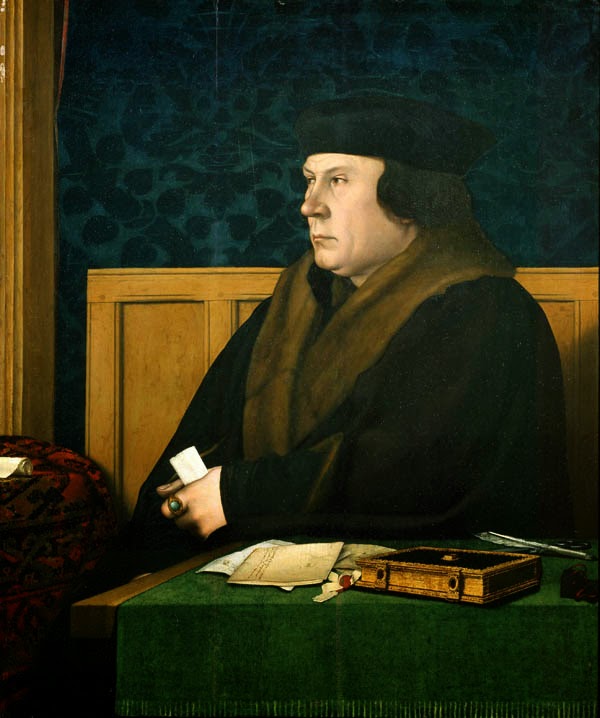
As for the protagonist, Thomas Cromwell – what a man. I loved Mantel's characterisation of him. The son of a blacksmith, he was raised in the school of hard knocks and was no oil-painting to look at, as the Holbein portrait proves. But, equipped with that rarest of educational attributes for his times - an international view of the world gained during his years in Europe - he rose and rose.

Cromwell's innate intelligence, broad-ranging competencies, basic humanitarianism and his own brand of moral compass enabled him to outsmart everyone of superior rank in society and fend off the court’s status-conscious wolves – for a time, at least. Just do the work, keep calm and carry on, that was his personal motto at court. It's a nice play on words that 'Wolf Hall' was the family home of Jane Seymour, who makes tantalising appearances throughout this book but is not yet in focus as Anne Boleyn's successor. As portrayed by Mantel, Cromwell was loyal to a fault to his family, friends and hired underlings, while his loyalty to his employers, first Thomas Wolsey and then Henry VIII, was the driving force of nearly every remarkable turn in history as England rejected the church of Rome’s authority and began to rule itself.

This is a wonderful book. I’m also thoroughly enjoying its sequel 'Bring Up the Bodies', a continuation of Cromwell's story and already containing reading gems by page four: now the sky is so clear you can see into Heaven and spy on what the saints are doing. It is her creative way of thinking which makes Mantel such a great writer. Oh that we creators of more modest tomes with history at the core could do half as well.

Saturday, 11 January 2014

The Women in Black

Hilary Mantel is right - this book by Madeleine St John is a pocket masterpiece, a jewel. Others describe the book as a comedy of manners, or a black comedy. Yes, true, but it is so insightful, so humane and oh so kind!

Where the era is concerned, Madeleine St John has 'nailed' it. I remember it well. I even worked in the scarf department on the ground floor of David Jones, Elizabeth St (the fictional Goode's Department Store) in the early 1960s, when I was a sixteen year old very similar to Lesley/Lisa. Having just completed the Leaving Certificate, on my way to Sydney Uni, I felt just the same as Lisa - my confined little world was expanding to embrace exotic individuals and life was full of exciting possibilities.

Madeleine St John took me back to the staff changing rooms, the staff entrance, cleaning the finger prints off the counter tops with metho each morning before the store opened (the author omitted that small detail - but then again, the Frocks Department was superior and did not have counters, like us). She reminded me that the class-conscious attitudes held by Sydneysiders about its various suburbs, and the geographic divide created by the harbour, is not a new phenomenon.

All those memories had faded, until I read this gem of a book, so cleverly structured, with seamless scene changes and not a word out of place. I marvelled that the author could recapture in 1993, and so perfectly, the life and times, the idiom and the cultural nuances from decades earlier.

I have one small criticism. Bruce Beresford's 'Introduction' should have come at the end, and Christopher Potter's 'Obituary' was superfluous. Text Publishing no doubt intended that Bruce's name, and his affectionate words, would enhance Madeleine's credibility and engage our initial sympathies towards her. Selected reviews indicate that this tactic backfired ... before they'd even read the first word of 'The Women in Black', some readers could only see the author as an eccentric. To me, she seemed brilliant, and very kind, if a lonely observer of life.

The book stands tall in its own right and may it long continue so.

Friday, 10 January 2014

The Peculiar Case of the Electric Constable

Carol Baxter's latest book The Peculiar Case of the Electric Constable is a genuinely interesting read.

Carol is highly-regarded in Australia as a genealogical researcher. Some years ago she befriended me at the state archival offices in Sydney and encouraged me to become a self-published author of family histories, following in her own footsteps. Since then, Carol's writing horizons have continued to expand and she has achieved commercial success in a field she describes as narrative non-fiction, her subjects being some of Australia’s colourful colonial characters including the bushranger Captain Thunderbolt.

In The Peculiar Case of the Electric Constable, Carol has told the intriguing story of a forger named John Tawell who was transported to Sydney in 1815, made his fortune in the colony and eventually returned to England, just like Magwitch in Great Expectations, the Charles Dickens novel of 1860. Thanks to Carol, Tawell is now flagged as having some significance in Sydney’s early history, but he was always an historical figure of interest in England. Carol has even pipped another writer to the post in recounting the wider significance of Tawell’s sensational trial for the poisoning murder of a certain Sarah Hart near Slough in the winter of 1845.

The Electric Constable is a good non-fiction read because Carol, who promotes herself as a ‘history detective’, is an expert when it comes to uncovering and converting historical material into riveting text. She tells the Tawell story in the active, not passive, voice, allowing readers to feel present in the moment. The story is well-paced, with accurate historical dialogue. In her Author’s Note at the end of the book she explains her technique, which works well when extensive supplies of contemporary documents and media reports of court hearings are available to the historian, as in this case.

The lengthy sections of traditional exposition of relevant historical events are also told in Carol’s lively and colourful style. A trained linguist, she has a commanding and impressive grasp of the English language, even if adjectives sometimes dominate. The book taught me much about nineteenth century topics of personal interest: the electric telegraph, the Great Western Railway, Quakerism (the ‘peculiar people’), British legal processes, chemistry, forensic medicine and aspects of Sydney in its early days.

However, Carol’s laudable attempt at tackling the genre of ‘true-crime thriller’ or murder mystery did not entirely work for me. Somehow the flow was not quite right, although Carol did keep me avidly turning the page to find out if Tawell really did commit the crime. It was scarcely believable that a man bent on murder, as the evidence portrayed him for much of the book, could have made so little effort to disguise his identity, and I found myself puzzled by many unanswered questions until the closing moments of the book - and afterwards.

Carol used the electric telegraph as the ‘hook’ for her story, but to me it was fundamentally about something else altogether – Tawell’s psychological profile. Without giving the game away here, that profile becomes clear at the end and it must make his case study a fascinating read for mental health professionals. The book also provides an excellent ‘how to’ lesson for all writers of non-fiction life stories from our past. I have certainly gained much from reading this book and I gave it a 4 star rating on Goodreads. Thank you, Carol.

Saturday, 10 August 2013

When the Money Runs Out

Beware the age of entitlement. That's the moral of Stephen D King's book When the Money Runs Out – the end of Western Affluence. The book is a tour de force, clearly explaining much of the world’s recent and past events in economic terms.

Yet it bags economists. As King says: ‘The dismal science has become a dismal failure … Its obsession with precision-engineered mathematical models – partly a consequence of the ability of computers to handle vast reams of often useless data – has made its conclusions both unintelligible to the average policy-maker and hopelessly unable to confront the uncertainties that prevail in the real world'. (p 258)

After attending King’s recent talk in Hong Kong (hosted by the Royal Geographical Society on 23 July 2013) and subsequently reading King’s book, I realise that I was lucky to have benefited from studying economics at the University of Sydney, at a time when economic history was a mandatory part of the course. And I was lucky that, in my twenties, I lived for five years in Papua New Guinea, a country about as far removed from the industrialised West as it was possible to be. Although I was young, I had inadvertently gained the economic perspective which King feels is lacking in today’s crop of economists.

Reading this fascinating book took me further on a trip down memory lane because, in my thirties, back in the late seventies and the eighties, I was in the vanguard of the field of country risk analysis and the setting of 'global limits' by banks. It was very ‘big picture’ stuff because I was required to analyse the creditworthiness of other countries and of international banks and distil this information into Board papers of no more than two pages in length. (Beyond that, the reader’s patience was exhausted!) Using this information, my employer, a major Australian bank, then made decisions on the extent of its willingness to lend money to other countries and other banks. At a time in the 1980s when many countries defaulted and new international banks were mushrooming, this pioneering work paid off and ‘my’ bank stayed out of trouble.

While King’s book also takes a ‘big picture’ view, it reflects the traditional focus of the author’s own nationality and domicile - England. He is essentially concerned with the Eurozone and the US, while Japan and Argentina are used throughout the book as exemplars of the economic consequences of national governments making wrong decisions.

Since he works for HSBC, and travels to Hong Kong, I couldn’t help wondering why King offered so little rationale for Hong Kong’s economic success, with only two mentions of Hong Kong. He describes Hong Kong today as ‘a wealthy, dynamic and fast-growing economy’ albeit one with ‘one of the highest levels of income inequality in the world’ (p 163). Elsewhere he mentions Hong Kong’s willingness to make extraordinary adjustments during the Asian financial meltdown in the late 1990s – ‘in Hong Kong, employees were called into management offices not so much to be let go – even though some redundancies were inevitable – but more commonly to be asked (or, more likely, told) to accept a pay cut of 15 or 20 per cent. The new reality sank in very quickly. International creditors had walked away and, with Asia now in stormy economic and financial waters, it was time to batten down the hatches’. (p 204) Why was this level of acceptance possible in Hong Kong specifically, and Asia generally, but not in the West? The explanation must lie with the attitudes of entitlement which have overtaken the West, but King seems unwilling to canvas this point explicitly.

Nor does he mention Australia, which would have presented King with a very worthwhile case study. In September 2011 its Treasurer, Wayne Swan, was named by the major journal Euromoney as the world’s best treasurer because of his adroitness in handling the Global Financial Crisis of 2008. In 1984 that same award went to another Australian treasurer, Paul Keating. Australia has been adept at making painful changes in direction. When the UK joined the Common Market (European Economic Community) in 1973, Anglophile Australia’s traditional export markets were badly affected. Australia had to face up to linking in with Asia. Treasurer Keating made a number of significant, if painful, structural reforms in the 1980s. A later Treasurer, Peter Costello, took advantage of a mining boom driven by demand from China to repay government debt and strengthen Australia’s budgetary position (although he squandered the golden opportunity to invest in infrastructure and education). Thus, when the Global Financial Crisis hit in 2008, Australia was in a sound budgetary position to take decisive action. Treasurer Swan took his officials’ advice to ‘go early, go hard and go household’, with an in-built exit strategy, and he also guaranteed the banks, with the result that Australia avoided the credit crunch, the recession and the unemployment which has hit hard in other countries. The government in which Swan served as Treasurer also attempted to refocus on education and infrastructure and reduce income inequality, all issues raised by King. What are the underlying reasons for Australia’s demonstrable ability to adapt and take decisive and timely action?

Turning to the actual theme of King’s book, his chapter headings are a good guide -

Whatever happened to the decades of plenty? King lists the miracle ingredients generating the economic miracle post WW2: the huge expansion in world trade; technological breakthroughs especially in telecommunications; the once-off increase in the labour force generated by women’s participation in the workforce; and financial market innovations, especially the growth in consumer credit. As one of the baby boomers whose entire life spans this period, I can attest to these benefits.

Taking progress for granted. King describes the industrialised Western economies as operating on the assumption that the past predicts the future, allowing us to count our chickens before they are hatched, without figuring in to the equation any ‘black swan’ (unexpected) events.

The pain of stagnation. The twenty-first century is not going according to plan and, in a world of illusion and collective delusion, policy-makers seem at a loss for a magic ‘fix’. King blames much of the West’s problems on decades of growth of a culture of entitlement – one’s rights now trump one’s responsibilities.

Fixing a broken economy. King cites many examples from history.

Stimulus junkies. King argues we are becoming addicted to policy-making drugs which may be doing more harm than good. He talks about the fiscal trap, the exchange rate trap, the zombie trap and the regulatory trap and the consequences for the world economy arising from governments jumping the queue in world capital markets, cutting off oxygen for the private sector. He laments the fact that central bankers, ‘supposed to stand above the political fray’ are being dragged into making political decisions about the distribution of wealth and have become the unelected power behind the throne.

The limits to stimulus. Here King uses the sterling crisis in the 1920s and the USA’s New Deal in the 1930s as lessons for today.

Loss of trust, loss of growth. Macroeconomic policies of either the conventional or unconventional kind are no longer working to rekindle growth because ‘something more fundamental is amiss’. We have lost trust in the underlying economic foundations of our societies – our financial systems, our government officials, our politicians and our fellow citizens.

Three schisms. King points to income inequality (the haves and have-nots), the rapid ageing of the population (intergenerational conflict) and declining trust between foreign creditors and domestic debtors as the central feature of economic and political life in the twenty-first century. These become much more of a problem at a time of stagnation because, when the economic pie does not grow, every winner creates a loser.

From economic disappointment to political instability. Such schisms are not new, and King cites many examples from history – the monetary upheavals of the 1870s and the Asian crisis of the late 1990s. Of the latter, King says ‘it is near enough impossible to imagine Western nations so meekly accepting such a sudden loss in living standards’, but Asia has rebounded stronger than ever. Three countries in Asia – Indonesia, Malaysia and Korea – tolerated the losses and adjusted to their new reality in three different ways, being willing to work hard because they were given a coherent narrative.

Dystopia (a very bad place) – King portrays ‘no growth, a loss of trust, a culture of blame, an unequal burden of austerity’ as the ‘dystopian world of economic and financial failure’. He believes that ‘persistent stagnation, accompanied by the creation of both winners and losers’, will only herald ‘the return of political extremism’ (nationalism and racism); reversal of globalisation and a return to protectionism; governments continuing to engage in wishful thinking, without dealing with the underlying structural problems; a mistrust of money; and more of the stately home effect (to keep living beyond our means, we will have to sell off our most saleable assets to foreigners). What’s more, the Eurozone crisis is ‘as much about the foolishness of the creditors as it is about the stupidity of the debtors’.

Avoiding dystopia. King says he makes no great claims about his proposals for the future, as there is no magic wand. But he suggests that adjustment can slowly be achieved with the following changes:
  • Ratings agencies should judge both borrowers AND lenders.
  • To survive as a monetary union, the Eurozone requires fiscal union
  • Countries need to commit to a medium-term debt-reduction strategy
  • Countries need to avoid policies which will disadvantage the younger generation and should continue to support expenditure on education, infrastructure and children’s health
  • Central banks should switch from targeting inflation to targeting nominal GDP
  • Less capital mobility will require increased labour mobility, both within and between countries
  • Banks as individual entities face a set of inconsistent objectives, so within each jurisdiction banks need better prudential supervision by a central authority
  • International banks need a different system of cross-border regulation
  • Banks need a much greater level of direct fees-for-service, and much less cross-subsidisation funded by risk-taking activities
  • Provision of more financial education for individuals
  • Provision of more economic history education for economists

After a fascinating exposition of the world’s economic woes and how we got to this point, an exposition I wish I'd retained the skills to write, I felt that the author had run out of puff by the end of the book. If only he’d ‘rested’ his manuscript for a bit longer and then spent a little more thinking time digesting the implications of his words before rushing to print, more insights for the world of the future might have emerged.

What do I mean? King’s book is premised on the fundamental need for growth in a capitalist system in order to keep people happy. It does not deal with the question of whether it is economically possible, in a resource-hungry and environmentally-stressed world, for the world’s still rapidly-increasing population to aspire even to current levels of Western affluence, let alone the West’s affluence if and when it is restored to an upward path.

It's wishful thinking to imagine that there could have been a final chapter suggesting ways of teaching people to begin to accept ‘steady state’ economics. Or a chapter explaining that the recording of economic growth is entirely dependent upon what we measure as economic activity. An ever-increasing number would result, and presumably make us feel happy, if we followed the example of recent attempts to price carbon pollution by placing a value on other aspects of life, such as the huge amounts of voluntary labour performed every day.

King points to the existence of a believable narrative as a factor in extricating Asia from its crisis. In the West, we too crave a succinct but coherent narrative from our political leaders, to take us forward with confidence. Perhaps King's final four paragraphs do that job, but I would have liked to see him expand these paragraphs a little more, and distribute them widely as his narrative, for free pick-up and delivery by politicians.

Saturday, 23 March 2013

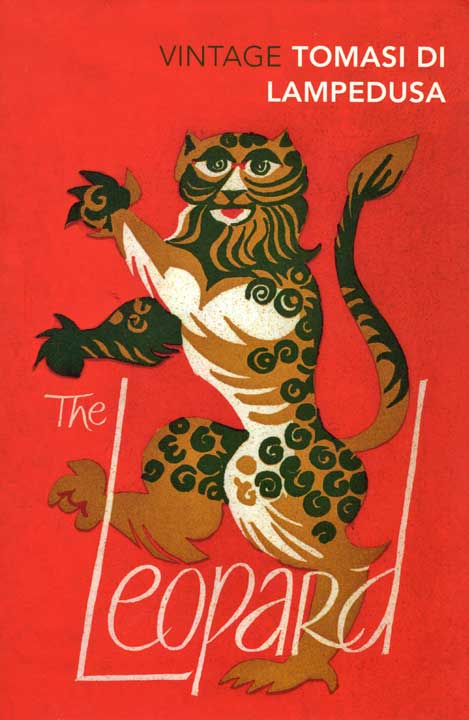
The Leopard

All writers of family history should read ‘The Leopard’, Giuseppe Tomasi di Lampedusa’s masterpiece about the life and times of his aristocratic Sicilian great-grandfather. But don’t bother with reading any Forewords or Introductions – read them later and jump straight into the main story, which begins at the time of Garibaldi's red-shirt campaign on the island of Sicily in 1860.

Perhaps my degree in economics, maths and statistics explains it, and all English literature graduates would scoff at my ignorance, but I can’t believe I knew nothing about this book until it became the latest Melbourne Athenaeum Library’s Book Club title. As a group, we rated it the highest of any book we’ve read in the last three years: everyone gave it 4½ or 5 stars, except for one participant, who grudgingly gave it one star and wondered what the rest of the discussion group was raving about.

The author’s ability to bring his great grandfather to life as a person, to tell us the essentials without burying us in tedious factual detail, was quite extraordinary. Although it is a work of historical fiction it has the same ring of authenticity and truth to it as Harper Lee’s legendary masterpiece, ‘To Kill a Mockingbird’, which was published around the same time. On a few occasions the author jumped forward to events up to one hundred years in the future, so that we saw the start of something and a brief ironic reference to the finish, without him taking us through the boring chronology of all the intervening steps – an interesting technique, cleverly used and instructive for all family history writers.

This book paints a superb picture of the human condition, especially the inevitability of decline and death in all its guises. Its opening line and closing paragraph proves that point conclusively, but subtly, as the opening line ‘Now and in the hour of our death' is in Latin, its significance easily missed. Although fundamentally sad, it’s a book which uplifts rather than crushes the spirit, perhaps because 'The Leopard' was an astronomer, viewing life and the universe on a grand scale.

You can open the book at virtually any page and delight in the use and power of the language. Its themes of society, religion and politics remain contemporary. And, with its frequent descriptions of the extremes of climate and the landscape features of Sicily, it’s a book which resonates with an Australian reader. It even contains the gorgeous aside that ‘eucalypts are the scruffiest of Mother Nature’s children’.

‘The Leopard’ has encouraged me to begin reading David Gilmour’s biography of the author’s life, ‘The Last Leopard’.

Monday, 14 January 2013

The Pillars of the Earth

I had to go to Hong Kong recently, which meant that I missed all but the first episode of the ABC's mini-series The Pillars of the Earth, based on Ken Follett's novel. Spotting his book on sale at Tullamarine airport, I bought a copy. It made for an intriguing in-flight read for a family history writer like myself, always grappling with the need to convey dense material in an interesting way. Follett's book contained some valuable lessons.

To begin, his book has not been out of print since it was first published in 1989, and the back cover blurb assures us that it continues to be one of Britain's best-loved books, proving his success in converting some extremely dense material into a good read. Who would believe that a book incorporating page after page of technical descriptions of the techniques used in building a medieval cathedral could sustain a reader's interest for 1,075 pages? Yet it did.

Anyone who's ever stepped inside Canterbury Cathedral in England would understand the impact of such a magnificent structure on the human soul. It is inspiring, uplifting, humbling, to be surrounded by such beauty and to think that men of bygone centuries could have known how to design and build such a masterpiece. I recall my single experience of attending Evensong at Canterbury. As the voices of those young choir boys filled the space and soared towards the distant ceiling, the American tourist standing beside me experienced the same outpouring of tears of pure joy as myself. Surreptitiously, I shared my small packet of Kleenex tissues with her.

The book taps into this ethereal feeling. But the text was also sufficiently concrete in describing building techniques that I often wished for the inclusion of extra illustrations. Certainly, line drawings introduced the six distinct time periods of the book, and explained at a glance the inspiring elevations of a medieval cathedral. Yet in-depth discussion of terms like nave, transept, cloisters and various outlying buildings formed a fundamental component of the book's plot and although I've visited many cathedrals over the years, I'm sure I wasn't the only reader hankering for a basic floor plan diagram.

Part of the book's success can be explained by the tenet write what you know: Follett has had a life-long passion for cathedrals. But he has the novelist's eye for character and drama and of course he incorporated the occasional titillating sex scene. It helps that a novelist is able to create characters as over-the-top as he or she cares to make them, whereas a family history writer tries to bring someone to life in a completely truthful and evidence-based way. However, Follett also has the knack of keeping the story moving along at the right pace, and this was his other lesson for me - his book reinforced my own aspirations to keep a good story at the heart of any family history book.